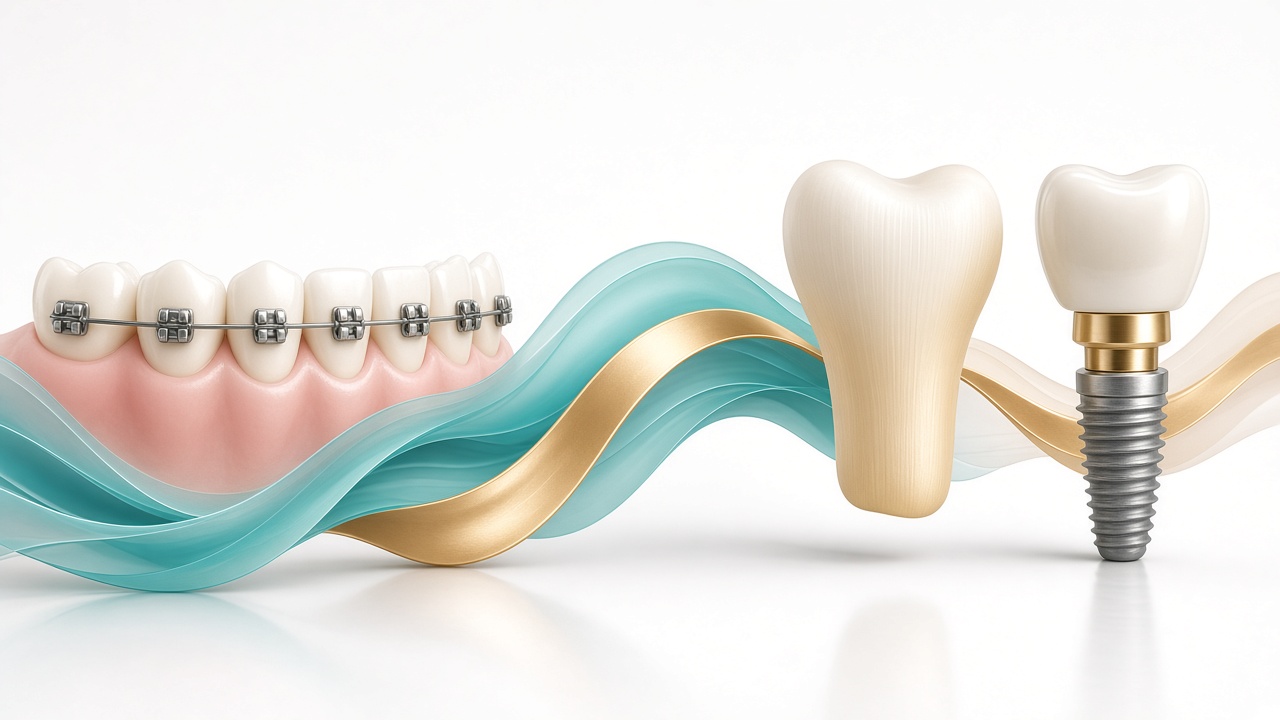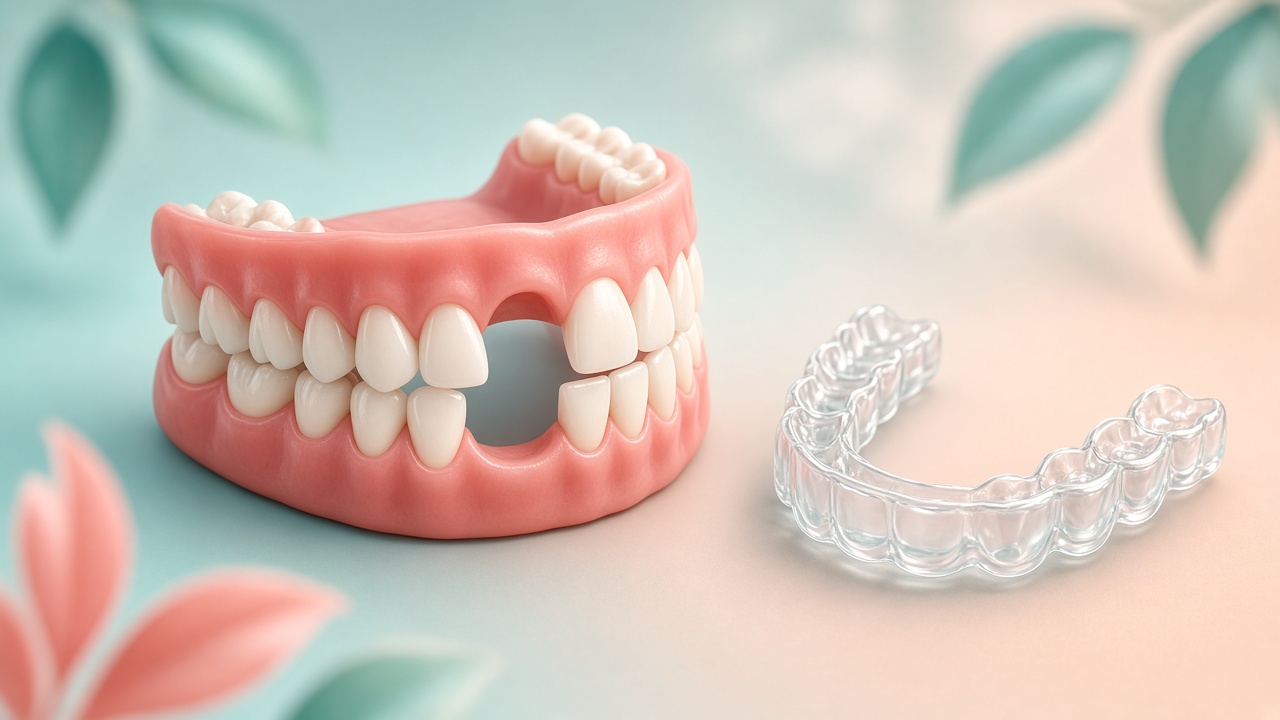
Braces with missing teeth are more common than the search line “can I straighten without a full set” suggests. A gap after extraction, a congenital missing tooth, an old bridge, or a plan for an implant all belong in the orthodontic conversation when the goal is clear: align what remains, close a space, open width for a future prosthesis, or mix both routes by segment. I am Dr. Maksut Behruzoglu, specialist orthodontist, PhD; in Dubai I manage these cases at the junction of adult orthodontics and pre-prosthetic preparation. A missing tooth changes biomechanics: neighbouring roots tip, opposing teeth over-erupt, space shrinks or drifts. An implant already in bone does not travel with the wire. Decisions follow exam, films, and agreement with a prosthodontist or surgeon — not a selfie. Below: what is realistically possible, where honest limits sit, and how not to lose space before the finish.
Patients often hear two extreme tips: “place every implant first, then fix the bite” or “close everything with braces, skip the prosthesis.” I start with a map of gaps and a spoken goal. Sometimes orthodontic space closure is more honest than an implant. Sometimes width must be held millimetre by millimetre. Sometimes we close one segment and prepare another for a crown. I do not diagnose a gap from a chat photo.
Why a missing tooth breaks a “standard” braces plan
A full arch gives symmetrical anchors and predictable contacts. When a tooth is gone, archwire force redistributes: neighbours drift into the void, the opposing tooth may erupt, the smile midline shifts in ways you miss in the bathroom mirror and cameras catch. Adults in Dubai often arrive years after losing a molar or premolar: “the space is small, just straighten the front.” Films already show tipped roots into the defect, lost bone height, and wear on the antagonist. A plan that ignores the gap fails in month three or four, when “simple alignment” hits empty space.
At consultation I ask history: when the tooth was removed, whether a temporary prosthesis existed, whether a bridge stood, whether an implant is planned, what chewing and aesthetic symptoms matter. Without that frame, talk about brackets is empty. The adult orthodontics page outlines the general adult route; with missing teeth a prosthetic layer almost always joins it. I dose forces more carefully on thin periodontium and on teeth that carried a bridge for years. A former bridge abutment can answer force differently from a free neighbour once the block is opened: ligament and bone lived in block mode.
Hygiene around a gap during braces is its own topic. Plaque gathers at the edges of a temporary “butterfly” flipper, at brackets next to the space, and where the tongue has learned to poke into the hole. Inflammation here damages both orthodontics and a future implant site. I schedule professional cleaning and a home protocol before bonding, not after the first bleed. Patients underestimate the tongue: a poke-into-gap habit can last months after space closure and undermine stability. I flag it on reviews if I see the habit mark on wax or on the temporary tooth.
Another layer is the “model arch” expectation. A full advertising smile and an arch with one or two missing teeth are different finishes. An honest plan names what stays as a gap until a prosthesis, what closes by movement, and what needs a midline compromise. You choose the goal out loud. I write it before the contract: a year later memory rewrites agreements. I also record whether you accept a second prosthodontic budget after orthodontics. Silent “we’ll decide later” almost always becomes a finish fight when the arch is straighter and the hole still asks for a crown.
Can you wear braces if teeth are missing
Short search answer: yes, often. Long answer: it depends on how many gaps, where they sit, bone and gum status, the goal (closure versus space holding), and any implants or bridges already present. “Braces are impossible with missing teeth” as an absolute is false. The true caveat: the plan does not copy a full-arch plan. Below are three typical scenarios I unpack in Dubai before promising a timeline “like my friend with every tooth.”
Before bonding you need a panoramic film or more detailed imaging when indicated, a periodontal assessment, and a restoration list. If implantation follows orthodontics, the surgeon or implant dentist should see the starting axes of neighbouring roots. Without that handoff you pay twice: once for a “pretty gap,” then again to reopen space for a fixture.
One missing tooth in a back segment
Classic after a molar or premolar extraction years earlier. Neighbours tipped, space narrowed. Orthodontics can upright roots and open width for an implant, or close the space by movement when biology and aesthetics allow. Choice depends on the opposing occlusion, profile, root length, and your patience for time. Closing “by eye” without contact analysis opens gaps elsewhere in the arch.
Temporary aesthetics for the course — a removable immediate partial, an adhesive bridge agreed with the prosthodontist, sometimes a composite pontic. Homemade pharmacy inserts wreck hygiene around brackets. I agree the temporary design before a long wire stage.
Several gaps or a “broken” arch
Two or three missing teeth in different zones complicate anchorage and midline control. Sometimes we segment: one side first, then the other. Sometimes we close small spaces and hold large ones for prostheses. Implants already placed freeze segments — we work around them or use them as anchorage under a separate protocol, not as ordinary teeth. I do not promise “perfect alignment around three implants” without naming compromises.
Patients with a partial denture must understand: the denture often needs remake or a temporary scheme compatible with the wire. An old clasp denture pressing on teeth under force fights the plan.
A front gap and camera smiles
A missing incisor or canine hits the midline and the “hole in the frame.” Orthodontics here either prepares symmetrical space for a future crown or implant, or closes space with later contouring (and veneers after, with the prosthodontist). Aesthetic compromise is named at the start: which tooth will “play” the missing role, which tip is acceptable, whether pink gum contour needs separate work. In Dubai on video calls patients often ask to “close everything with orthodontics, no implant.” Sometimes that works. Sometimes gum and bone in the defect will not give a clean closure without a prosthesis — and honesty belongs in the first visit.
Rest and speech smile photos help set priority: what colleagues see, what only you see in the mirror. I do not treat Stories; I treat contact and support.
Close the gap or hold space for a prosthesis
This is the main fork for braces with missing teeth. Closure means moving neighbours so the space disappears (or becomes clinically acceptable). Holding space means calibrating width and root axes for a future implant, bridge, or other prosthetics. Mixed plans by segment are possible. The choice is not “implants are trendier” or “closure is trendier.” It follows occlusion, bone, face, two-specialty budgets, and how long you expect to live in the Emirates.
I draw both scenarios on a scan or model before you pay for a full course. You see where the midline and canine will go. Without that picture, a year later comes the fight “I thought the implant would just fit.” Below is how I unpack criteria at the pre-prosthetic preparation junction. The orthodontist does not replace the prosthodontist: I prepare space and axes; crown shape, colour, and abutment type belong to prosthodontics; bone for a fixture belongs to the surgeon. Three rooms, one written sequence before the drill and before full orthodontic fees.
When space closure is reasonable
A young adult with adequate bone, favourable opposing occlusion, willingness for longer movement, and no hard need for “my own tooth” exactly in that seat — candidates for a closure discussion. Sometimes space is closed after planned orthodontic extraction (different logic: the tooth was removed for space, not lost years ago). With an old defect, closure needs root assessment and resorption risk on a long path.
I warn: closing a chewing gap changes contacts and can overload remaining teeth if antagonists are not coordinated. Finish bite control is part of the job, not a nice extra.
When space is held for an implant or bridge
A gap that is too narrow or too wide in the wrong place, thin bone, need for chewing support exactly there, an already agreed implant plan, high aesthetic demand for a tooth shape orthodontics cannot “draw” by moving a lateral — reasons to hold and calibrate space. Orthodontics here is millimetre preparation: root parallelism, coronal gap width, gum level when possible. Too narrow breaks the implant plan. Too wide leaves a food trap and a contact hole.
After debond, space is held with a retainer, temporary crown, retention trays, or an agreed splint. Without space retention, neighbours drift back into the void in weeks. I say this before the surgeon’s drill.
Mixed plan on one arch
On one jaw you can close a small space after loss of a small tooth and open another zone for an implant. That needs anchorage (sometimes temporary anchorage devices when indicated) and visit discipline. You get a stage calendar, not one slogan. Count orthodontic and prosthetic budgets separately; UAE policies often split them — your policy administrator checks; I do not invent insurer tariffs in an article.
If a bridge already spans the gap, we discuss with the prosthodontist: keep the block, temporarily section it, or replace it for the course. I do not order “saw the bridge because it suits the wire” without the prosthodontist.
Pre-implant preparation: what the orthodontist does before the fixture
The pre-prosthetic preparation route is exactly that junction: upright axes, gain or reduce space, remove bite compensations that masked the defect for years. The implant goes into a ready zone. “Fixture now, bite later” can work when the implant will not block needed moves and position is already acceptable. Often after years without a tooth in Dubai, the position does not look acceptable on tracing.
I agree with the surgeon a target gap width in millimetres and acceptable neighbour root tip. You hear one number from two doctors. The clash “orthodontist said it fits, surgeon said bone is short” appears when films and goals never sat on one table. In practice I ask for at least a short written confirmation of target millimetres: a corridor handshake does not survive six months.
Soft tissue after tooth loss is often collapsed. Orthodontics can improve contour partly through tooth position, but it does not replace gum grafting when grafting is indicated. I do not promise “gum will grow back from braces.” If grafting is needed, timing with the surgeon is separate. Pink contour in the front camera zone matters more to some patients than a perfect back contact; we name priority before choosing closure versus implant.
A temporary tooth while waiting for the implant must not wreck hygiene or fight the wire. Form and support are agreed with the prosthodontist. Flights from Dubai: the temporary should be repairable without waiting weeks for “the main doctor,” or patients remove it themselves and lose both aesthetics and habit. I note in the plan who repairs the temporary when I am away and how to reach help at night if a clasp or wing breaks.
Smoking, uncontrolled systemic factors, and active periodontitis around an implant zone are stop factors for complex combined plans. Orthodontics can then run in a limited dose or wait for stabilisation with the relevant physician. I do not “treat diabetes with braces” and I do not replace an endocrinologist. If the physician asks to delay surgery, orthodontics may prepare space with firm retention until the implant window. We agree the window; we do not guess it.
Separately: the antagonist over the gap. A tooth that erupted into emptiness for years blocks both the temporary and the future crown. Sometimes it needs intrusion in the same course. Patients think we treat only the hole; we also treat the over-erupting partner. Without that, the final crown sits low or overloaded.
Bridges, removable prostheses, and aesthetics during treatment
While orthodontics runs, a smile hole hurts camera work and habitual chewing. Temporary options are agreed before bonding. A removable immediate partial (“butterfly”) is popular, yet a poorly fitted flipper rubs gum and packs plaque at brackets. The prosthodontist fits it; do not file acrylic at home with a nail file. If the flipper presses after an activation, come earlier: the tooth moved, the prosthesis stayed old.
Thin adhesive bridges are sensitive to differential movement of abutments. Often they come off before full forces and get replaced with another temporary scheme. A classic bridge as a rigid block limits independent tooth movement: we either respect the block in mechanics or the prosthodontist temporarily sections it. The decision is joint. You should hear one answer from two rooms in one week, not “orthodontist said cut it, prosthodontist said never” without a shared file meeting.
Aligners suit some patients with gaps for hygiene around a temporary tooth when biomechanics allow. Fixed appliances are sometimes more honest for large root moves at a defect edge. I choose the system after diagnosis, not from “invisible trays always” feeds. Wearing trays ten hours instead of twenty while calibrating implant space fails the same way as on a full arch: “almost ready” on screen, not ready in the mouth.
Night grinding with a temporary and braces raises chip risk. If bruxism is already in the history, we discuss protection within what the appliance allows. Homemade hard trays over a wire without a clinician break both plan and neighbour enamel. Report temporary chips before the monthly visit: delay turns a small chip into lost aesthetics on a key meeting.
Separately: “I’ll put veneers on neighbours so the gap disappears.” Optics do not upright roots into a void. If roots aim into emptiness, a veneer repeats crooked geometry. Orthodontics is primary for axis; surface aesthetics come after or on an agreed stage with the prosthodontist. The same for a composite “build-out” of a gap without an axis plan: it blocks hygiene at a future bracket and creates a false sense that the defect is solved.
Diet with a temporary: sticky dates, road nuts, gum on clasps — common breakage reasons for Dubai expats. I give a short restriction list for your construction, not a poster that bans all hard food. If the temporary is camera-critical, book a spare prosthodontic slot before a long trip.
Timelines, risks, and honest plan limits
Time with missing teeth is often longer than “simple front alignment.” You need months for uprighting, space gain, antagonist control, and surgeon visit logistics. I give a corridor after diagnosis, not one advertising number. Flights, missed visits, and debonds on neighbour crowns stretch the calendar more than the gap itself. Adults in Dubai compare themselves to a teenager in the next chair and resent “slow” progress at a space: defect biology and prosthetic logistics matter more than passport age. A written goal at start later prevents “I thought we would close without metal before the wedding.” Below are three limits I speak before the contract so finish does not become a fight about someone else’s Stories.
What lengthens treatment with a gap
Long closure paths, work on an over-erupted antagonist, waiting for a surgeon window, remaking temporary aesthetics, cautious forces on thin periodontium — typical lengtheners. Changing the goal mid-course (“front only at first, then suddenly a full implant plan”) rebuilds consent and calendar. I stop quiet expectation drift without a new talk.
Skipping activations “because of a project” while calibrating implant space is especially costly: millimetres drift back while you are on another continent without retention. Before a long trip we agree a pause plan, not a “stiffer wire just in case.”
Risks I name out loud
Root resorption on a long closure path; space loss without retention; inflammation under a temporary prosthesis; midline compromise; temporary aesthetic remakes mid-course; inability to idealise an arch around an implant already placed. I do not guarantee “the implant will sit perfectly after any braces” — perfection depends on bone and surgery. Risk talk belongs before payment, not on debond day when emotions already sit at the finish.
Smoking and hygiene failures at a defect spoil a future implant zone more than bracket brand. With an inflammation flare I pause activations. Arguments about “lost months” are secondary to saved bone.
What I do not promise and what we do
I do not promise skeletal profile ideals without surgery on large disharmony; moving an implant; ideal pink aesthetics from wire alone after heavy atrophy; teenage speed on adult periodontium. We do dosed movement of remaining teeth, space calibration, prosthetic sequencing, and space retention. I do not invent AED prices without a dated fee list. After the plan, administration quotes a frame. Insurance covers orthodontics and implants differently — verification is on your side.
| Scenario | Typical orthodontic goal | What usually follows | What often breaks the plan | Bring to consultation |
|---|---|---|---|---|
| One back gap, space narrowed | Upright axes, open width | Implant / bridge per prosthodontist | Space loss after debond | Films, year of extraction |
| One back gap, space wide | Reduce gap to target width | Implant or closure | “Close vs implant” fight without a model | Aesthetic and chewing goals |
| Front gap | Symmetrical space / closure with contouring | Crown, implant, veneers | “Pretty without prosthesis” promise on collapsed gum | Smile and speech photos |
| Several gaps | Segments: where to close, where to hold | Combined prosthetics | Different doctors without one plan | List of prostheses and implants |
| Implant already placed | Bypass / anchorage / line compromise | Neighbour finishing | Expecting the implant to “move” | Implant passport |
| Old bridge across a gap | Respect block or temporary sectioning | New bridge / implants | DIY “saw cut” | Prosthodontist contacts |
| Removable partial denture | Wire compatibility | New denture or implants | Clasps fighting force | Bring the denture |
| Goal “front only” | Limited volume + honest back defect | Observation / stage 2 | Quiet drift to full ideal | Written goal |
How diagnosis and coordination work in Dubai
At adult orthodontics consultation with missing teeth I collect the goal, gap map, periodontium, films, and work list. Then I frame the close-versus-hold fork and needed colleagues. If the route is prosthetic, we lean on pre-prosthetic preparation logic. You leave with a sequence, not the single word “braces.” In Dubai, life horizon in the country shapes the plan more than an advertising timeline: one year, three, or unknown changes whether a full implant junction fits here. If you move in four months, an honest stage beats “we’ll finish everything.” Hiding a move and demanding a full combined course is a bad start for bone and for the contract. Bring a list of prior extraction and prosthesis clinics — it saves a second blind visit. Below are three practical blocks I start with on the first visit.
Films and records needed at start
A panoramic for overview of gaps and roots. Periapicals or cone-beam imaging when indicated — especially before implants and with complex anatomy. A scan or impression for movement modelling. Face and smile photos. Without these, “bond and see” with gaps is risky.
Old films from before extraction, if kept, show how much bone was lost. An implant passport if a fixture already sits. A short list of medicines and systemic conditions: they affect healing and surgical clearance; the orthodontist does not replace your physician for medical disease.
How I join the plan with prosthodontist and surgeon
One goals file: millimetres of space, which tooth we do not touch, which temporary aesthetic, when the wire comes off relative to the drill, which space retention. You keep a copy. If the prosthodontist is in another clinic, we need contacts and willingness for a short call or letter. “They’ll figure it out” without numbers ends in remakes.
I do not dictate implant brand. I dictate the geometry of space orthodontics can deliver. If bone cannot host a fixture even with an ideal gap, the surgeon says so, and we change the plan before a wasted year in brackets.
What you control during the course
Attendance, hygiene at brackets and around the temporary tooth, messages about breakage and flipper pressure, elastics as prescribed, space retention after debond. Smoking and hygiene lapses spoil a future implant zone more than any braces brand. I stop activations if inflammation flares at the defect — without a fight about “lost months.”
Travel: wax, spare elastics, photos on breakage, understanding that hotel pliers are a bad idea. Carry a removable temporary in hand luggage. Night retention after space calibration is treatment, not “if I remember.”
Russian-speaking patients often ask whether missing-tooth orthodontics is done “back home.” It is. The filter everywhere is tissues, goal, and prosthetic junction. Dubai daily life differs in visit logistics and in the language of “finish before relocation” promises. I work with the arch in front of me and the calendar you name honestly.
If fear remains that “orthodontics is pointless without a full set,” reframe the question: what is the goal for the remaining teeth and the future prosthesis. The answer is built on exam. This article frames braces with missing teeth and the prosthetic junction. The chair decides millimetres. Booking an exam costs less than a year of chat advice that promises “implant only” and “close with braces only” without films.
FAQ
Can I get braces if one or several teeth are missing?
Often yes. The plan accounts for gaps: space closure, space holding for a prosthesis, or a mixed scenario. An implant already placed does not move itself. Decision after exam and films, not from a gap photo in chat.
Is it better to close a space with braces or place an implant?
It depends on occlusion, bone, aesthetics, two-specialty budgets, and your goal. Sometimes closure is more honest. Sometimes space is calibrated for an implant. I show both on a model before choice; there is no universal “better” without the mouth.
Do I need orthodontics before an implant if space “seems there”?
Sometimes visible space exists while neighbour roots converge and block the fixture. Sometimes the gap is too wide. Orthodontics on the pre-prosthetic preparation path is about axes and millimetres. Whether you need a course is a joint review with films.
What about the smile hole while I wear braces?
Temporary options are agreed by orthodontist and prosthodontist: removable immediate partial, another temporary scheme after removing a thin bridge, and so on. Homemade inserts wreck hygiene. Pressure from a temporary after activation is a reason to come early.
How long does treatment take with missing teeth?
The corridor is usually longer than simple front alignment because of axes and space work. I give a frame after diagnosis. Flights, debonds, and mid-course goal changes stretch time more than the gap itself.
Can aligners replace braces when teeth are missing?
Sometimes yes, if biomechanics and wear discipline allow. Sometimes fixed appliances are more predictable at a large defect edge. The system follows the task, not invisibility ads.
What happens to space after debond before the implant?
Space must be held with a retainer, temporary, or agreed scheme. Without retention, neighbours drift into the void again. Timing to implantation is agreed with the surgeon; orthodontics does not end with a “freedom party” at that stage.
Can you decide from photos whether we can close without an implant?
No. Exam, root and bone assessment, and bite analysis are required. Photos help state the complaint. I do not approve gap plans without films. An adult orthodontics exam costs less than a year of mirror arguments and chat advice.