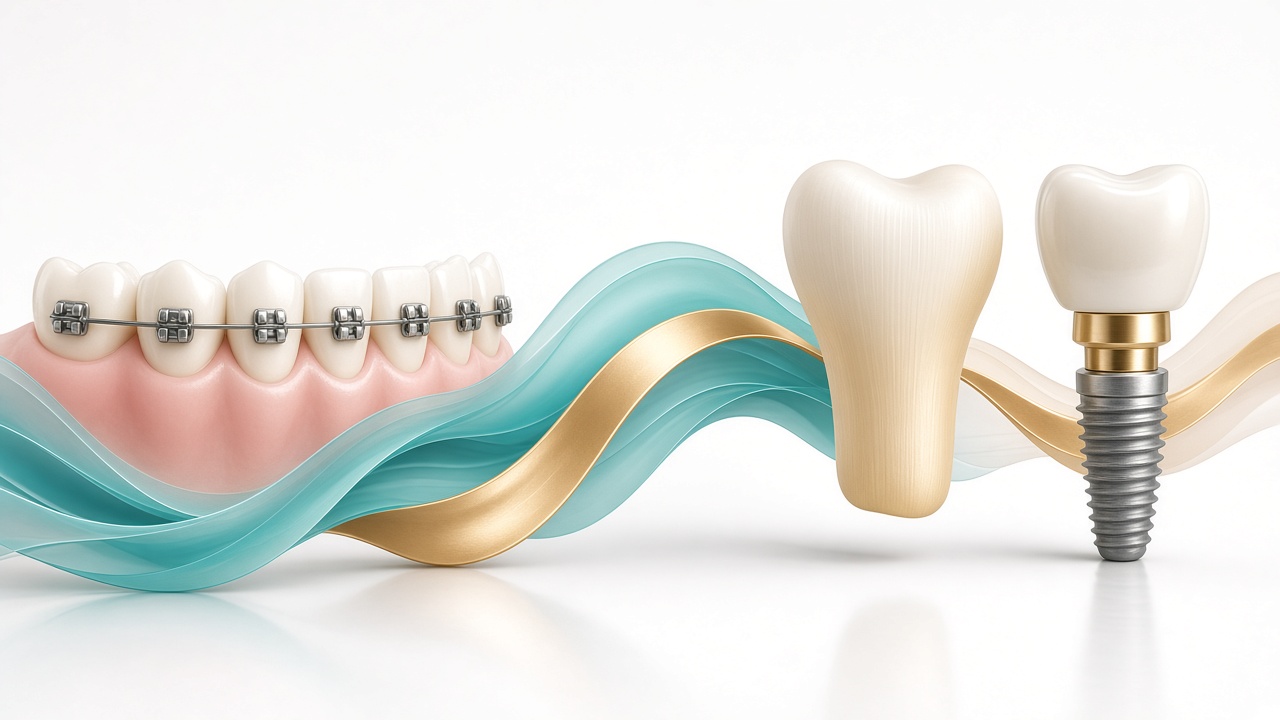
Patients ask: “Why move teeth if crowns come anyway?” Fair question. A crown, bridge, or implant finishes form and function, yet they sit on the geometry you leave them. Orthodontics before prosthetics prepares space, root axes, abutment parallelism, and contacts so the prosthodontist and surgeon work in a ready field instead of “working around” a crooked gap with ceramic. I, Dr. Maksut Behruzoglu, specialist orthodontist, PhD, run these Dubai plans only as a team: orthodontist, prosthodontist, and when needed surgeon and periodontist. Pre-prosthetic orthodontic reviews from 2022–2025 describe gains in hygiene around the prosthesis, load distribution, and soft-tissue margin aesthetics — without promising that an implant will “integrate perfectly.” Implant success depends on bone, soft tissue, medical status, smoking, hygiene, and surgical skill; orthodontics does not issue an osseointegration guarantee. Below: why move what will later be crowned, which scenarios are common in adult orthodontics, and how to read sequencing without the fairy tale “crowns first, sort it later.”
Why move what a crown will cover
A crown follows the stump and tooth axis. If the tooth tips into a defect, the crown gets an overhanging margin, hard hygiene, and overload. If bridge abutments lean into a “teepee,” path of insertion suffers: the prosthodontist either removes more tooth or accepts a compromise. If the implant site is too narrow or too wide, the surgeon places the fixture where space allows, not at the ideal arch point — then neighbours and ceramic argue for years.
Orthodontics before a prosthesis solves concrete jobs: open or close space, upright an axis under a future stump, level the occlusal plane, extrude or intrude for crown height, undo migration after an old extraction. This is not “treatment for Instagram straightness.” It is field engineering for someone else’s work. I show models: here is the gap now, here is where roots will travel, here is where the margin will sit. Without pictures, “crowns will hide everything later” sounds convincing and often lies.
An adult Dubai mouth already carries fillings, canals, old bridges, neighbouring implants. A work map is the first plan document. Without it I do not prescribe force “just in case.” Sometimes the prosthodontist says: move minimally. Sometimes: without uprighting, the crown will fare worse. The decision is joint. I do not replace the prosthodontist or promise their finish.
Hygiene is another layer. A crooked gap and tipped neighbours collect plaque at the future prosthesis margin. Beautiful ceramic with poor hygiene around an implant or crown edge leads to inflammation sooner. Orthodontics here serves brush and irrigator access, not beauty for its own sake.
Ferrule — the band of tooth tissue under a crown — also suffers from a bad axis and short stump height. Orthodontic extrusion when indicated can gain height before prep. That is a narrow protocol: not every broken tooth is a candidate, and extrusion does not always replace surgical crown lengthening. Decision with the prosthodontist. I do not sell extrusion as a universal rescue.
Patients compare orthodontic months with “a crown in two weeks.” The comparison is fair only if you count service life and remake risk. A short path without geometry sometimes ends as a long path of remakes. I put both calendars side by side without lectures.
Typical scenarios before crowns and implants
At consultation I most often see a few portraits. First: a tooth removed long ago, neighbours tipped into the defect, little room for an implant. Second: a broken tooth headed for a crown, but the axis points the wrong way and the gum margin is uneven. Third: a bridge on poorly parallel abutments, patient wants a remake. Fourth: gaps and migration after periodontal disease, need arch stability before large prosthetics. Fifth: an implant already sits “off the arch,” and the new plan works around it as a compromise — orthodontics does not move an implant.
Each portrait needs its own force volume. Sometimes a local shift of two teeth is enough. Sometimes a full course with space retention until surgery. I name volume after films and a talk with the prosthodontist, not after “just put an implant in.” In Dubai emigration often adds a layer: work done in different countries, films lost, implant brands unknown. Then the first step is finding the implant passport or targeted diagnostics before promises of “we’ll place the same one.”
Closing a gap with orthodontics instead of an implant is a separate fork. Sometimes it is a conscious choice. Sometimes the span is too large. I unpack both doors without slogans that implants are always or never required. Below are three scenarios I unpack on models most often.
Space for an implant after old extraction
Neighbours tip in, the antagonist extrudes, width “by eye” misleads. Orthodontics spreads roots, levels the occlusal plane, sometimes intrudes the extruded tooth. The surgeon receives an agreed width. Without that step implants often land in a compromise point, and ceramic later fights the smile line. Space retention until surgery is mandatory: otherwise months of bone waiting let the gap shrink again.
Patients ask: “Why not implant and graft at once?” Sometimes yes. Sometimes neighbour roots stand so that even with graft a fair implant diameter risks the neighbour’s periodontium. Films decide, not the wish to rush.
Axes under crowns and bridges
A tipped tooth under a crown gives an uneven margin and hard hygiene. Teepee bridge abutments force more prep for a common path of insertion. Uprighting before prep saves tissue and simplifies the margin. I agree parallelism tolerance with the prosthodontist in millimetres, not in the word “roughly.”
If an old bridge still sits, the prosthodontist decides whether to remove it before orthodontics or temporarily section it. Do not “saw the bridge” yourself after chat advice.
Periodontal migration and gaps under a new prosthesis
After bone loss teeth fan out; gaps appear that patients want closed with a new bridge “fast.” Force on unstable periodontium is dangerous. Stabilise first, then dose gap closure, then prosthesis. I do not promise that orthodontics cures periodontitis. I promise not to move in active inflammation.
Temporary splinting and orthodontics in this scenario are agreed with the periodontist. Otherwise a pretty new bridge sits again on mobile abutments.
Joint plan: orthodontist, prosthodontist, surgeon
Pre-prosthetic preparation is not an orthodontist solo show. Without the prosthodontist I do not know final crown height, material, desired gum margin, or remake budget. Without the surgeon for implants I do not know bone width and height needs, soft-tissue needs, or loading timeline. A patient who “starts braces with one doctor, then finds an implantologist” often gets two incompatible plans. I insist on an early call or joint visit.
In Dubai the team is often split across clinics and emirates. Then I ask for a written goal list from the prosthodontist: gap width in millimetres, axes, occlusion, whether extrusion for ferrule is needed. The clearer the brief, the fewer “tweaks” at orthodontic finish. Below is how I split responsibility at start so nobody promises someone else’s result.
What the orthodontist locks in the plan
Tooth and root positions, move sequence, appliance, space retention after debond, periodontal risks, interfaces with existing implants as fixed anchors. I draw what moves and what stays. I promise a time corridor with attendance and biology caveats, not “implant on 1 June for sure.”
If an implant already sits in the zone, it becomes a mechanics border. Neighbours move relative to it. The illusion that “we’ll tweak the implant with the wire” is dangerous: the implant is fused to bone and does not travel with orthodontic force.
What the prosthodontist locks
Smile and chewing design at finish, prosthesis type, whether old bridges come off, temporary crowns for the course, prep tolerance after new axes. The prosthodontist says whether “almost parallel” is enough or a jewel-precise axis is required. I fit mechanics to their tolerance, not the reverse in silence.
Ceramic shade and aesthetics are their field. I do not promise crown colour. I promise agreed tooth position for their work.
What the surgeon locks for implantation
Bone and soft-tissue volume, need for grafting, timing after orthodontics to placement, loading protocol, smoking and systemic factors as prognosis filters. I hand over gap width and neighbour axes. The surgeon does not receive an integration guarantee from me — and I do not give one to the patient on surgery’s behalf. Honest language: orthodontics prepares the field; osseointegration is a separate biologic process with its own risks.
If the surgeon sees bone deficit, orthodontics does not “grow bone with a wire” in the household sense. Sometimes orthodontic extrusion improves soft tissue and bone level on a specific tooth before extraction — a narrow indicated protocol, not a universal graft substitute. Team decision.
Diagnosis and mouth prep before force
Force on top of caries, active pockets, and sinus tracts is a poor start for pre-prosthetic orthodontics. Sanitation and periodontal stability first. Then films: panoramic, CBCT of the implant zone when needed, periapicals for abutment canals. Digital scan and photo protocol freeze the start for the whole team. Without that base I do not prescribe a wire “for future crowns” from a verbal gap complaint.
I ask patients to gather a disk or link of prior work: when the bridge was placed, which implant, any failures, smoking, sugar control if diabetic. Hidden history breaks someone else’s careful plan. Inside adult orthodontics this data collection takes the first visit no less than arch exam. Below are three blocks I prefer before starting movement “for crowns.”
Sanitation and periodontium
Caries next to a future abutment, overhanging old crown margins, bleeding — restorative and periodontal care first. Moving a tooth in inflammation risks support that must later carry a prosthesis. I pause without romance about “making Ramadan.” Supportive hygiene during the course is mandatory: professional cleans on an agreed rhythm. Plaque at brackets plus a future implant is a bad combination for bone. Patients with periodontitis history stay on pocket control for the whole course, not only “until bonding.”
Films and implant site
Bone width and height, sinus position, nerve path, biotype thickness — surgeon language. The orthodontist checks whether we can orthodontically gain width between neighbour roots without dangerous approximation. Sometimes the patient sees “room for an implant,” while CBCT shows neighbour roots leaving a slit too narrow for a fair-diameter fixture without risk. Then we move roots or change the prosthetic plan. I do not assign gap width “by smile eye.” Millimetres are agreed with the surgeon. Old panoramics without bone volume for implant planning are often insufficient — the surgeon says that, not a braces ad.
Temporary teeth and aesthetics during the course
Immediate partials, temporary crowns, adhesive bridges for the course — all must repair in one visit and not break hygiene. Dubai travellers are vulnerable: a temporary tooth breaks on a work trip and the “main” prosthodontist is away. Agree a repair backup early. Do not file acrylic at home with a nail file. Temporary front aesthetics matter for work. Strength and brush access beat one-month gloss. If a temporary presses after wire activation — come earlier: the tooth moved, the prosthesis stayed old.
Sequencing timelines: space retention and implantation
Orthodontics finished — space is not obliged to wait forever. Without retention neighbours drift back into the defect. A tray, fixed retainer, temporary tooth that holds width — part of the plan until surgery. I say this before bracket removal. Otherwise the patient rests three months “metal-free” and the surgeon again sees a narrow gap. Dubai adults often delay implants for visas, leave, or clinic changes: life calendars fight gap biology. Below are three handoff points where teams lose months most often.
After debond: who holds the width
Space retention is a separate appliance and habit. A removable tray without night wear does not hold a defect. A temporary tooth must seat so it does not push neighbours back. I check width with a template or scan if surgery is far. A patient who “debonded and vanished” returns with a surgeon surprise.
When the surgeon places the implant
Timing is the surgeon’s call by bone and soft tissue. Sometimes soon after orthodontic stability. Sometimes after grafting and healing. Sometimes after extraction with delay. I do not promise surgery dates for the surgical team. I hold neighbours and pass current millimetres. Smoking and systemic factors re-enter the surgeon’s filter at this step — orthodontics does not cancel them.
Crowns on natural teeth after movement
Prosthodontists often wait for soft-tissue and micro-shift stability. Prep “the next day” is not always possible. Temporary crowns for the course and finals after retention are different budgets. Align prep day with both doctors. Build flight buffers: I prefer a one-month shift to losing space between trips.
When orthodontics is shortened or skipped
Not every prosthetic plan needs a full course. Sometimes the prosthodontist closes a local defect and accepts an axis compromise. Sometimes bone volume and medical status make implants undesirable, and a removable prosthesis proceeds without tooth movement. Sometimes patients refuse orthodontic time consciously: I record the refusal and consequences for hygiene and prosthesis service life — without pressure and without promising that “it will be ideal anyway.”
An existing implant in a non-ideal position limits the dream of a perfect arch. The plan either works around it or, in rare hard indications, the team discusses complex replacement — not routine “for arch beauty.” I do not push removal of an integrated implant for orthodontic convenience. The patient must hear that step’s price from the surgeon: bone loss, new timeline, new risk. The orthodontist does not sell implant removal as a “light plan clean-up.”
Ankylosis and severe periodontal support loss also shrink orthodontic contribution. Then prosthetics leans on other teeth or implants, and movement is minimal. An honest minimum beats theatre of a full course on teeth that will not take force. I show on film which teeth are abutment candidates, which may be for extraction by team decision, which for careful movement.
Veneers “instead of” pre-prosthetic orthodontics with crowded roots and planned crowns get a separate unpack: optics do not replace an axis under ferrule. Sometimes minimal alignment first, then prep. Sometimes patients choose more prep without orthodontics — knowing the enamel price. In Dubai comparing two budgets (orthodontics plus conservative prep versus thick veneers on crooked axes) helps decide without the illusion that ceramic forgives root geometry.
If general anaesthesia or sedation is planned for major surgery, the orthodontic stage still runs on its own visits: the wire is not placed “while under” as a trick. Force and surgery calendars are joined early so nobody promises one magic day.
Risks, expectations, and team money
Pre-prosthetic orthodontics adds months and budget before ceramic. Patients resent the “extra” stage until they see the cost of remaking a bridge two years later because of a bad axis. I put both calendars on the table: with orthodontics and without, with service-life caveats — without a forever-years guarantee. In Dubai visa logistics often mixes with the resentment: people want the mouth “closed” before departure. I respect the calendar and still name the biologic minimum. A compressed timeline without a ready field shifts risk onto the crown margin and bone at the implant — it is not a saving.
The table below is team talk language, not a price list. I name AED figures after a dated plan. Policies often split orthodontics and prosthodontics under different rules; check cover separately. The insurer’s administrator confirms limits, not a blog or clinic story.
| Scenario | Orthodontic job | What we prepare for prosthodontist/surgeon | Typical risk without movement | Space retention | What I do not promise |
|---|---|---|---|---|---|
| Narrow gap after extraction | Spread neighbour roots | Width for agreed implant diameter | Implant “off site” / implant declined | Tray / temporary tooth | 100% implant integration |
| Tipped abutment for crown | Upright axis | Parallelism, margin, ferrule | Overhanging margin, overload | Retainer as planned | Eternal ceramic without care |
| Teepee bridge abutments | Parallelise | Common prep path | Excess prep / compromise | Until prosthodontist handoff | Ideal without second opinion |
| Extrusion for crown height | Dose extrusion | Stump height, tissues | Crown on a stump without ferrule | Stabilise before prep | Zero mobility always |
| Migration after periodontitis | Close gaps in doses | Stable arch under prosthesis | Gaps under a new bridge | Long monitoring | Periodontitis cured by a wire alone |
| Implant already off-angle | Work around / limit | Arch compromise | Ceramic vs axis fight | Per neighbour plan | “We’ll move the implant” |
| Close defect without implant | Bring neighbours together | No gap | Empty defect / other prosthesis | Mandatory | That implants “won’t be needed for everyone” |
Three reading rules. First: the risk column is a choice prompt, not a scare. Second: space retention is not optional. Third: implant success is not a line in the orthodontic contract.
Smoking, uncontrolled diabetes, bisphosphonates, and other systemic factors are discussed by the surgeon and physician. I build them into a start pause when I see red flags, and I do not mask them with “align first, sort it later.” Patients sometimes ask me to “look away” from smoking for a wedding date. I do not: tissues read nicotine better than a celebration calendar.
I welcome a second opinion on sequencing. Different prosthodontists tolerate axis compromise differently. Compare millimetres and photos, not only braces price. If two plans contradict each other on gap width — gather the doctors in one talk before paying both courses. An hour on a call is cheaper than two incompatible contracts.
Team money in the UAE often arrives as three invoices: orthodontics, surgery, prosthodontics. A policy may cover one and exclude another. I do not merge others’ fees into one “dream package” without figures from colleagues. Ask each for orientation before start. Ceramic after pre-prosthetics delights when a surprise budget is set early, not when a temporary tooth lives a third year “while we save for the implant” without retention.
FAQ
Is orthodontics required before every implant?
No. If space, axes, and tissues are already favourable, surgeon and prosthodontist may proceed without orthodontics. Orthodontics is needed when geometry blocks honest placement or hygiene. Films and team exam decide, not an ad package of “implant turnkey in a week.” Bring CBCT to consultation if you already have it — the talk shortens.
Can I place crowns first and move teeth later?
Sometimes crowns on natural teeth travel with the root, but margin and form after a large shift often need remake. Placing expensive final ceramic before major movement risks paying twice. Temporary crowns for the course are a different talk. An implant after orthodontics is often cleaner than orthodontics around an implant already sitting in a tight site — order depends on the defect. Sequence beats bracket brand.
How long does orthodontics before prosthetics take?
The corridor depends on the job: local shift and full course live on different calendars. I name months after diagnosis and the prosthodontist’s brief. Comparing with someone else’s “four months from stories” is useless. Attendance, hygiene, and biology move the timeline. Periodontal pauses also belong in the real calendar.
Do you guarantee the implant will integrate after alignment?
No. Orthodontics prepares space and axes. Osseointegration depends on bone, soft tissue, surgery, medical status, hygiene, smoking, and other factors. I do not guarantee implant success. Ask the surgeon for prognosis on your films. An honest surgeon speaks in probabilities and conditions, not “it always integrates.”
What happens to the space if I wait six months after braces before the implant?
Without retention neighbours often narrow the gap again. With retention and a temporary tooth, width holds better. Agree waiting time with the surgeon and me: sometimes bone is waiting, sometimes grafting. “Just wait without a tray” is a common reason for a second orthodontic round. A pre-surgery control scan catches surprise earlier than the surgeon’s chair.
Do I need a periodontist in this plan?
Often yes: inflammation, thin biotype, recession in the smile zone, history of tooth loss. Stable periodontium is a condition for force and for tissue prognosis around implants. I delay start with active pockets. A joint exam saves “whose zone” arguments mid-course.
Can aligners alone prepare for a prosthesis?
Sometimes yes, if biomechanics allow space and axis gains with trays. Sometimes root control and complex vertical tasks are more honestly handled with braces. System choice follows the job, not fashion. Wear discipline for pre-prosthetics is critical: “almost enough space” for an implant does not count. Budget extra aligner series into timeline expectations.
How do I start if prosthodontist and orthodontist are in different clinics?
Bring a written brief: prosthesis goal, desired width, timelines, temporary constructions. I can write a movement plan with numbers for your prosthodontist and surgeon. A joint video call in Dubai saves months of chat threads. The pre-prosthetic preparation page is exactly this handoff; booking adult orthodontics starts with a work map, not a bracket brand. Put prior clinic names in the same folder as your films.
Team work saves nerves at finish. A patient who changes prosthodontist after orthodontics without passing millimetres often hears “space is short” or “axis is wrong.” I write a handoff note: gap width, root angles, retainer type, control-scan date. Put that note in the new doctor’s chat before first prep.
Another Dubai lifestyle layer is expecting a turnkey package in one clinic by a fixed date. Pre-prosthetic orthodontics rarely fits an ad calendar of “smile by October” if bone needs pause and periodontium needs stability. I prefer shifting ceramic day to handing the surgeon an unready gap. Ceramic on crooked geometry costs as much as on straight geometry and serves worse.
If you already started orthodontics “for beauty” and an implant plan appears later, say so at once. Part of mechanics can retarget to defect width. Silence until debond buys a second force round. At consultation I re-ask prosthesis goals even for people who came “just to straighten”: adult plans often change mid-mouth life.
Control after prosthodontist handoff is also part of the agreement. I ask for temporary-crown margin photos and a scan before final ceramic if many months passed. Neighbours can creep quietly. An early signal is cheaper than a surprise in the surgeon’s chair. That is how orthodontics before prosthetics stays field engineering — not a promise of someone else’s surgical miracle.
Separately: there is no “implant guarantee from the orthodontist” in my contract. I answer for tooth movement, space retention, and agreed millimetres. The surgeon answers for placement and healing protocol. The prosthodontist answers for margin and occlusion. You answer for hygiene and attendance. When roles merge into one ad line of “all-inclusive and it will integrate,” disappointment is almost certain. Read roles aloud before payment. Write surgeon questions separately from mine so no room answers for another stage.
If one question remains — “do I need to move, or can I go straight to crowns?” — only exam, films, and a prosthodontist brief answer. Booking adult orthodontics with a work map saves a second blind consultation. Bring goals in one paragraph: what we will restore, by which horizon, what already sits in the mouth. The talk then starts with engineering, not bracket brand. I am ready to adjust after the surgeon’s bone reply — that is normal team sequence, not a weak start.