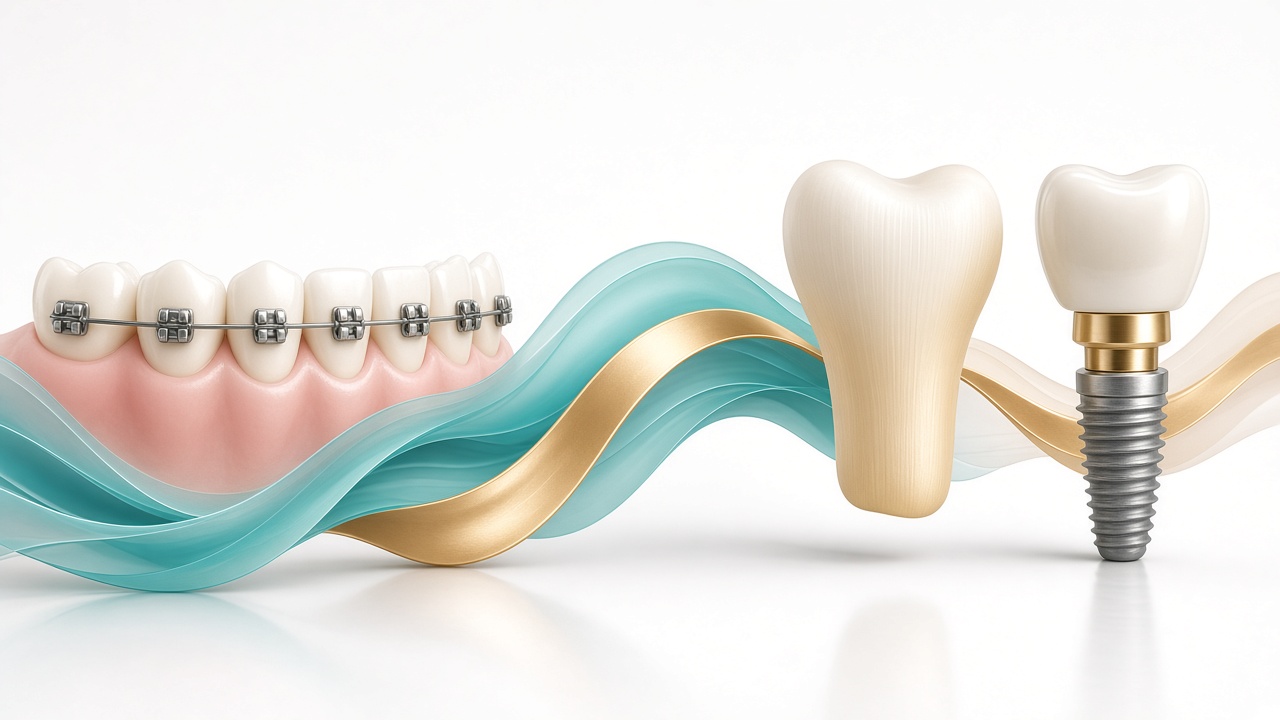
Tooth extraction for braces enters the plan when the arch lacks space for a straight row, or when heavy incisor protrusion breaks lip balance and occlusion. It is not a penalty for crowding and not a mandatory step before every bonding. I am Dr. Maksut Behruzoglu, specialist orthodontist, PhD; I treat patients in Dubai after years in Istanbul. At consultation I measure millimetres of shortage, lip profile, bone thickness, and gums before I talk about premolar removal, enamel stripping between contacts, expansion, or distalization. Below is a calm map of indications and alternatives — without scare lines about “half the mouth gone” and without a promise of “braces without extraction always.” Your case needs exam and films; I do not approve an extraction plan from a chat photo.
Patients often arrive with two ready answers: “someone already said pull the fours” or “I want zero extractions at any cost.” Both close with facts from the mouth. Sometimes we find space without removal. Sometimes extraction protects gum and profile better than forcing teeth forward. Wisdom teeth and orthodontic premolar extraction are different conversations; do not fuse them into one sentence.
Why we discuss tooth extraction for braces at all
Extraction in orthodontics creates space in the dental arch. That space pays for crowding alignment, retraction of protruding incisors, midline correction, or redistributing gaps. A removed tooth does not return: the choice is permanent. So I do not open with “we must extract.” I open with how much space you need and which tools can buy it.
At consultation I review models or a scan, an OPG, CBCT when useful, profile and smile photos, and gum status. Adult braces often need this talk in more depth: growth is finished, restorations and recessions shrink the “just expand” margin. A teen with residual growth still has time as a helper; an adult has dental mechanics, a compromise, or surgery. Below are three decision pillars I say out loud before referring to a surgeon.
Arch space and the size of crowding
Crowding is measured in millimetres: how much the arch lacks for every tooth to sit without overlap. Mild shortage often closes with interproximal reduction (careful enamel reduction between teeth within safe limits), modest expansion, or controlled tipping. Moderate and severe shortage already argue with profile and bone thickness at the incisors. Pushing front teeth far forward to “save” every unit can ask more of gum and cortical bone than tissues can give.
Textbook numbers do not replace your scan. Two patients with “five millimetres of crowding” look different: arch form, lip thickness, gingival biotype. I show on screen where incisors travel without extraction and with extraction, and I name the price of each path for profile and periodontium.
Incisor position and facial profile
Incisors that sit too far forward give a convex profile and lip strain at rest. Premolar extraction in those cases often helps retract the front segment so lips close with less effort. If incisors already stand upright or slightly back and the lip is thin, aggressive extraction can flatten the profile. I therefore read crowding from above on the model and the face from the side: lip line, mentolabial fold, smile display.
Dubai patients sometimes bring social-media before-and-after grids. Someone else’s starting profile is not yours. Extraction decisions attach to your photos and cephalometrics when needed, not to a stranger’s gallery.
Periodontium and bone thickness
A thin gingival biotype at the incisors tolerates heavy proclination poorly. Extraction can be a way to keep roots inside bone, not a doctor’s hardness. Sometimes gums are inflamed first: we treat periodontium, then recalculate the orthodontic plan. I do not load full forces over active inflammation for the sake of a pretty row.
Smoking and vaping worsen tissue prognosis. Not a lecture — a recession risk calc for every space plan, with or without extraction.
If the goal is only “front teeth photogenic” while posterior bite stays a compromise, extraction volume can change. We narrow the goal in writing before braces start, not mid-course after premolars are already gone.
When extraction is truly indicated — and when it is debatable
An extraction indication stacks several factors at once. Crowding alone without profile and bone is a weak argument. A lovely profile with severe crowding and no space is also an incomplete answer. I lay out paths: extraction, non-extraction with alternatives, reduced scope, sometimes orthognathic surgery for an adult with a large skeletal class. You hear comparisons: where incisors will sit, months of gap closure, gum risk at the canines.
The American Association of Orthodontists (AAO) stresses individual diagnosis before a plan — not “extract fours for everyone” or “extract for no one.” The plan fits the mouth, not clinic fashion. In Dubai, flights and crowns change calendars, not millimetre math. Below: where extraction enters more often, and where I hunt another path on your models.
Severe crowding and lack of space
When shortage is large and the arch is narrow, aligning everything without space drives incisors forward and out. Some patients accept that aesthetically; others collect recessions and an unstable finish. Premolar extraction opens a pocket of millimetres that neighbouring teeth close. Which teeth leave (often first or second premolars) depends on caries, root form, bite, and smile aesthetics.
Sometimes one tooth leaves to fix a midline or asymmetry. “Always four” is a myth. We count by sides and by jaws separately.
Heavy protrusion and lips apart at rest
If lips do not meet at rest because incisors push them apart, space behind the front segment helps retract it. Here extraction often sounds like a working tool, not an extreme. Alternatives such as molar distalization can work, but they need anchorage, elastic discipline or temporary anchorage devices, and time. At consultation I compare timeline, patient load, and profile forecast.
Bite compensation and prosthetic setup
In adults with missing teeth or planned crowns, extraction sometimes redistributes space for a future prosthesis. That is a joint map with the prosthodontist, not “just a straight row.” I plan adult braces in those cases with implant or temporary restoration timing.
A large skeletal Class II or III in an adult without surgery sometimes forces dental compensation — including extractions. I draw compromise borders before start so nobody waits for a jaw to “catch up” on its own.
Grey zones: moderate crowding with a favourable profile; a patient who wants every tooth kept while bone is thin; carious teeth that make more sense to remove than healthy premolars. In a grey zone I prefer a second opinion or an extra CBCT slice over rushing the surgeon.
Alternatives: expansion, IPR, distalization
Before the word “extract,” I list working alternatives and where biology stops them. An alternative is not marketing for “no extraction at any cost.” It is another risk set and timeline. You choose knowing the price: enamel from IPR, where adult expansion hits a wall, months of distalization with TADs and elastics.
In Dubai, adults often heard ads for “aligners without extraction.” Appliance brand does not cancel space math. Aligners and braces apply related biomechanics with different tools; a millimetre deficit stays a deficit. I show on the scan how much space each path buys and where thin bone or lip profile breaks it. Below are three routes I unpack most when extraction is not yet the only answer.
Arch expansion
Expansion widens the arch and frees space laterally. In a growing patient, skeletal maxillary expansion can still change the suture. In an adult, suture response is limited: talk is more about dental tipping and careful expansion within bone. Over-expansion in adults raises recession risk at laterals and stability problems. I show on the scan the line past which “a little wider” looks pretty on screen and harsh on gum a year later.
Crossbite and a narrow upper arch are serious reasons to discuss expansion. “Expand everyone instead of extracting” without a bone read is a poor plan. On films and in the mouth I check room to expand, occlusal interferences, and how the tongue rests on the palate. A night appliance or removable expander in an adult without a skeletal indication often disappoints: space arrives slowly while tipping grows faster than ad copy promised.
Interproximal reduction (IPR)
IPR is measured enamel reduction between teeth to free space. Within safe limits it is predictable for mild and some moderate crowding, for triangular tooth shapes, and for easing black triangles after alignment. I state millimetres before the procedure and polish surfaces so plaque does not sit on roughness. You see the number before and feel the smoothness after — no surprise “a little from every contact by eye.”
IPR does not replace extraction when shortage sits at seven to eight millimetres with heavy protrusion. Trying to grind too much enamel to refuse a needed premolar extraction hurts teeth more than an honest removal by indication. Sensitivity after IPR is usually short; lasting pain or a chip needs an earlier visit. Fluoride and hygiene after the procedure sit in the home sheet the same way as after bonding brackets.
Distalization and temporary anchorage
Moving posterior teeth back frees space in front. You need anchorage (often mini-screws), elastic discipline, vertical control, and time. Adults with implants already in place or short roots have tighter distalization limits. I name how many months space collection will take and what happens if elastics skip weeks. A mini-screw is not magic: it is temporary bone anchorage, placed and removed by protocol, with hygiene around the head mandatory.
Sometimes we combine: a little IPR, a little expansion, targeted distalization — and extraction is not required. Sometimes the mix still hits profile limits, and extraction stays cleaner for tissues. If a colleague promises “distalization in two months for everyone,” ask about anchorage, vertical control, and your periodontium: a stranger’s timeline without those three points is advertising, not a plan.
Surgical assists in adults (for example surgically facilitated expansion) enter only with clear indications and a surgeon — not as a “no extraction” slogan. If someone offers extraction “because it is faster for the clinic,” ask for written justification on models and profile. If someone refuses extraction “because reviews look happier,” ask for the same bone calc: a review does not replace millimetres on a scan.
One Dubai practical layer: you may compare three plans in a week between Business Bay and Marina. Carry the same film folder and the same question list. Then doctor differences show in numbers, not in waiting-room charm. I am fine if you leave to think: permanent choices do not need a same-day close.
Wisdom teeth versus premolar (“four”) extraction
Patients mix two plots: “remove wisdom teeth before braces” and “remove premolars for space.” Different teeth, different goals, different timing. Wisdom teeth often enter for pericoronitis, caries on the neighbouring second molar, cyst risk, or lack of eruption room. A premolar leaves an orthodontic plan as a space source for arch mechanics. Search phrases about tooth extraction for braces often fuse the two — in the chair I split them into two plan lines.
At consultation I separate those lines in writing. Otherwise a month later you cannot recall why those exact units left. Below is how I set accents so the decision does not become a general fear that “everyone gets pulled,” and so the surgeon receives an unambiguous referral.
Wisdom teeth alone rarely create classic orthodontic space where incisor crowding needs correction. Removing eights does not replace premolar math. Sometimes eights block molar distalization — then they leave as a mechanical obstacle, not as a ritual before braces. Sometimes healthy impacted eights without pathology are watched on films at agreed intervals. I do not sign “remove all wisdom teeth just in case” as an orthodontic necessity without OPG findings and without a mechanics plan.
A carious or broken premolar can be the better extraction candidate than a perfect neighbour: removing the already weak tooth often reads fairer than sacrificing an ideal first premolar. We read restoration prognosis, canals, bone, and position in the arch. Rarely we keep a damaged tooth temporarily as anchorage and remove it later — only with the restorative dentist aligned.
Asymmetry: sometimes different teeth leave on right and left. I fix the plan with diagrams and a signature so a surgeon in another Dubai clinic does not guess from memory. If you transfer care from another country, bring a written map of removed teeth: “upper left four” muddles records across languages.
Healing protocols after wisdom removal and after premolar removal differ, as do windows when I will bond force in the zone. The surgeon clears the socket; I do not load a fresh swelling for a wedding calendar. Swelling, fever, foul odour from the socket — see the surgeon before a routine wire visit.
If another country said “all eights first, then we think about braces” without crowding analysis — bring films. We rebuild the logic. If someone said “braces impossible without eights out” while impacted teeth lie quiet without pressure on sevens — ask for the rationale, do not argue in chat. A second orthodontist in Dubai should see the same films as the first; otherwise plan comparison is empty.
Timing: extraction relative to braces placement
Extraction timing links to bonding day and to the gap-closure phase. There is no universal “exactly two weeks before.” We weigh surgical volume, number of teeth, how you feel, travel, and Dubai work with cameras and meetings. A patient with four extractions and a patient with one asymmetric extraction get different recovery windows; I do not copy a stranger’s calendar from a support chat.
A common path: diagnosis and plan → extraction on referral → healing → braces placement or bonding on remaining teeth with the zone added later. Sometimes braces are already on, and extraction happens mid-treatment once the wire prepared the segment. Both paths work with sound mechanics; confusion starts when extraction happens “just in case” before a plan. Then the patient loses a tooth while the orthodontist later learns space could have been bought another way — or that different units should have left.
Closing a premolar space takes months. Elastics, root parallel control, early socket hygiene are part of the course, not a footnote. Roots should stand parallel in the closure zone; otherwise the finish shows gum triangles and unstable contacts. I book denser visits in the closure phase, especially for adults, where bone answers more quietly and skipped elastics from work hurt more. Two weeks of missed elastics in this phase show clearer than in early front alignment.
If a UAE policy splits payment for extraction and orthodontics, verify cover with your plan administrator yourself. I do not sign insurer guarantees or invent DHA tariffs for you. A braces payment plan need not include surgical extraction — read the contract before the surgeon booking.
Flights right after extraction: leave a buffer. Swelling in a cabin and pain in another city spoil the start more than shifting bonding by ten days. If the trip is already bought, say so at consultation: we move the surgical day rather than “tough it out at the airport.” Gym and contact sport in week one after extraction follow the surgeon; the orthodontic wire later does not cancel socket rules.
Food in the first days stays on the soft side of the menu; full load on the extraction zone returns with comfort and surgeon advice. Pain medicine follows the label — without masking rising swelling and fever. A message to the clinic solves a complication faster than a third tablet and silence until the next monthly slot.
Face, airway, and myths around extraction
Fear that “the face will collapse after extraction” and “extraction ruins breathing” shows up often. Let’s keep it calm. Profile changes with incisor position and soft tissue, not with extraction as a magic event. Extraction with proper retraction of protrusion often settles the profile: lips meet with less strain, the mentolabial fold looks softer. Extraction on already retrusive incisors and a thin lip can flatten appearance — so indications are read before surgery, not soothed with “the face will adapt.”
On breathing and sleep-disordered breathing, AAO updated materials converge on no proven causal link between orthodontic extractions and development of airway obstruction. Extraction decisions rest on crowding, bone, aesthetics, and bite. Orthodontics does not replace sleep medicine if you have snoring, daytime sleepiness, or diagnosed apnea. Palatal expansion in a child with a narrow maxilla is a separate skeletal talk; it is not “treating apnea by removing fours” in an adult.
The myth that “modern orthodontics never extracts” is as false as “everyone loses four.” Evidence-based practice keeps both tools: keep and remove by indication. I do not promise zero recession risk on every path, and I do not scare with “the face will fall” when profile numbers do not show that. Another myth: “aligners are smarter than braces, so extraction is never needed.” The appliance does not erase a space deficit; it changes how force is applied.
Stranger reviews saying “they extracted and everything got worse” without starting photos and diagnosis are weak for your plan. We read your models. If you doubt, take a written plan with alternatives and timelines: second opinions in Dubai compare cleaner without heat. Ask on paper: which teeth, why, what happens without extraction in a year for gum and profile forecast.
Parents of teens sometimes fear extraction more than the teen. I explain to teen and parent in one number language, without different stories in different rooms. Adults decide themselves; I give risks straight. If you already had teeth removed abroad “for future braces” without a full plan — bring films and the list of units. We rebuild mechanics on what remains, without blame and without a promise to undo removal.
What I check at consultation before an extraction referral
A short checklist before the surgical referral: your goal in your words; measured space shortage; profile and smile line; periodontium; caries and prognosis for each extraction candidate; alternatives with numbers; visit load and timeline; retention after; prosthetic link if crowns or implants are planned. The consultation page and this list match in spirit; an article does not replace the chair. I write down what you want to keep at any cost (every tooth, profile, a date) and what you will discuss — otherwise half a year later the fight is about forgotten priorities.
Films should be recent. A five-year-old OPG from another country without root and pathology notes is a weak base. In Dubai we often take our own set by clinic protocol even when the Moscow or Istanbul packet is thick. Record translation helps; the clinic still owns its diagnosis. If you arrive after “a friend dentist already pulled them,” we record the fact and plan on what remains — without pretending a wire can restore lost units.
Adults on the adult braces path more often bring crown and implant histories: they change which teeth are logical to sacrifice and where roots should travel. Teens need that layer less. Both ages get one principle: diagnosis and numbers first, surgeon second.
| Plan question | Non-extraction (typical) | Premolar extraction (typical) | What we check together |
|---|---|---|---|
| Space shortage | Mild / part of moderate | Moderate / severe | Millimetres on scan, not “by eye” |
| Incisor position | Already upright / mild tip | Heavy protrusion | Lip profile at rest |
| Gingival biotype | Thick, stable | Thin, recession risk if proclined | Periodontium before forces |
| Alternatives | IPR, expansion, distalization realistic | Alternatives hit bone/profile limits | Written scenario compare |
| Timeline | Depends on mechanics | Plus gap-closure phase | Work and flight calendar |
| Irreversibility | IPR enamel does not fully return | Tooth does not return | Consent before surgery |
| Wisdom teeth | Separate decision | Separate decision | Do not confuse with premolars |
| Prosthetic finish | Space for crowns/implants counted alone | Redistribution often clearer | Link with prosthodontist |
I can refuse extraction “because a blogger said so,” and I can insist on extraction if the non-extraction plan breaks gum. Both refusals are clinical positions, not haggling. If you leave to compare clinics, take the candidate-tooth diagram and the alternative list: second opinions stay honest. Ask the colleague the same questions: how many millimetres of shortage, where incisors go without extraction, recession forecast, months of gap closure. “Just trust us” without numbers is a reason to seek another explanation — not necessarily another clinic philosophy.
Documents in hand: treatment plan, extraction map, timeline range, what orthodontics includes and what the surgeon bills separately. UAE policy rules differ; verify cover yourself. I own the medical logic of the braces plan, not the insurance contract text.
FAQ: tooth extraction for braces
Do braces always require tooth extraction?
No. Many plans finish without extraction through IPR, expansion within bone, distalization, or moderate tipping. Extraction enters when space is short, protrusion is heavy, or prosthetic logic asks for redistribution. Diagnosis decides, not an internet headline.
How do premolar extractions differ from wisdom tooth removal?
Premolars in orthodontics more often leave to create space for alignment and incisor retraction. Wisdom teeth are a separate story: pathology, interfering position, distalization prep. One does not automatically replace the other.
Can I have braces without extraction if crowding is severe?
Sometimes yes, if alternatives truly buy millimetres and periodontium tolerates the path. Sometimes without extraction incisors move farther forward than bone and profile allow. At consultation we compare scenarios on your models.
When can braces go on after extraction?
After the surgeon clears healing and when the bonding plan is ready. The gap can be days to weeks depending on surgical volume and how you feel. I do not print “N days for everyone” without seeing the socket.
Will extraction ruin my facial profile?
Profile follows incisor position and lip tissue. With correct indications, profile often settles. With wrong indications, retrusion can deepen. We read profile photos before the decision, not after surgery “on luck.”
Does extraction harm breathing?
Current reviews and AAO positioning do not support a causal link between orthodontic extractions and airway obstruction. Sleep complaints belong with a sleep clinician. The orthodontic plan rests on bite, space, and tissues.
Does closing the space after extraction hurt?
Feelings match ordinary activations: a dull phase for days, individual. Strong pain beyond a week, swelling with fever, pus — contact the clinic before the next planned visit. Wear elastics by the sheet; skips lengthen closure.
What if another clinic said extract and I disagree?
Ask for a written plan with measurements and alternatives. Bring films for a second opinion. I will remeasure space and profile; sometimes I confirm extraction, sometimes I offer another path with other risks. Chat argument without models does not replace an exam.