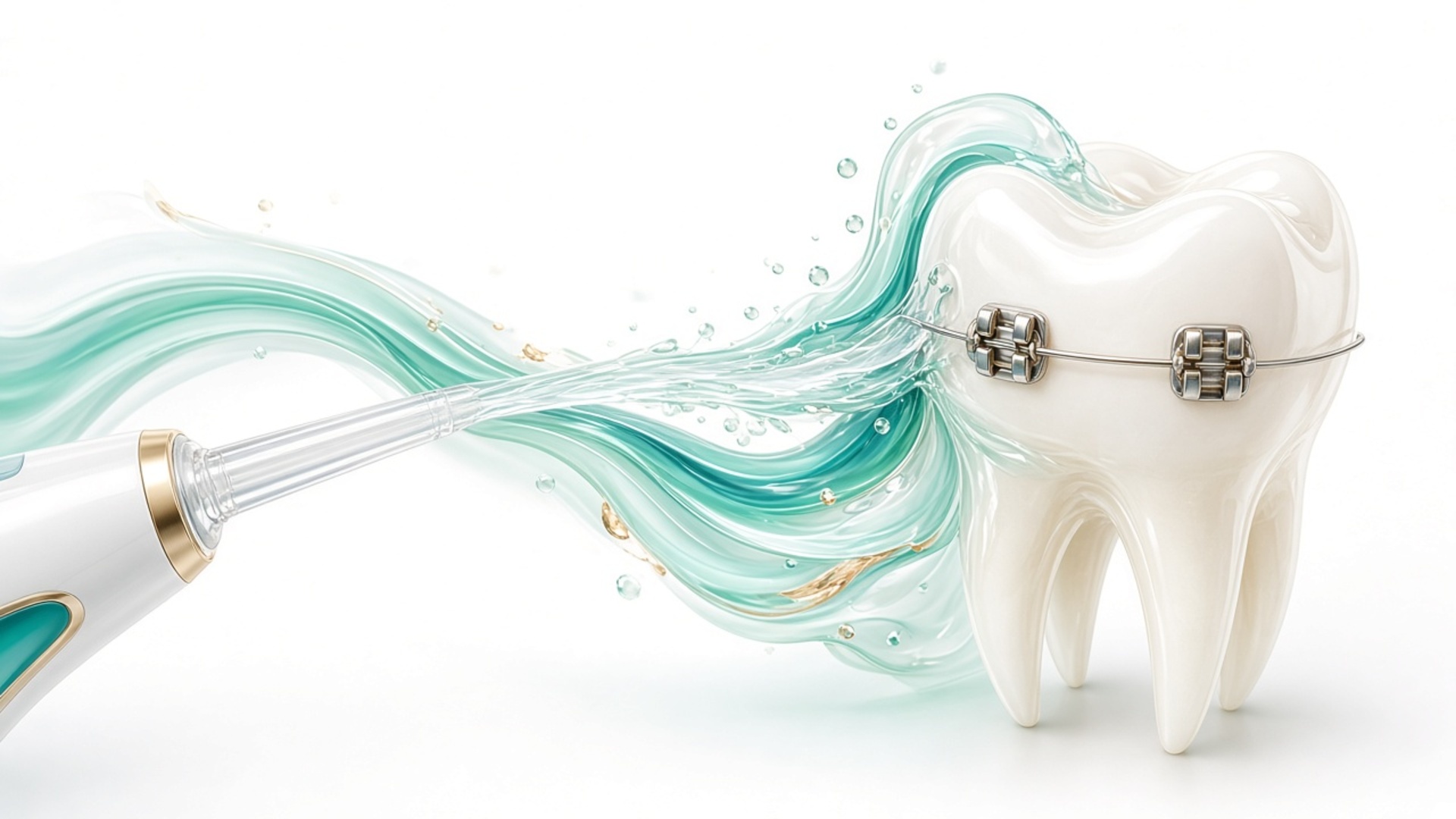
A water flosser with braces rinses soft debris and food from around brackets and under the wire. It does not replace a toothbrush with paste, and it does not replace interdental brushes: a water jet does not strip dense biofilm as reliably as mechanical cleaning. I treat patients in Dubai on metal braces and other systems; at reviews I see people who keep a clean mouth without a device, and people whose tartar climbs around hooks within weeks without a jet. Below is a straight take: what the unit does, when buying one in Dubai makes sense, how to set pressure, how a travel unit differs from a countertop model, and which mistakes bruise the gums. Your case is settled at consultation and chairside hygiene checks, not by a shop display.
What a water flosser does with braces — and what it does not
A pulsed or continuous water stream under pressure knocks rice, meat, and bread out of the zone between bracket and gum, from under a ligature, and from the gap at an elastic hook. After a Dubai lunch — shawarma, rice, dates — you often feel something stuck that a bathroom mirror never shows. A water flosser gives fast access without threading floss under the wire on every tooth. That is convenience and a hygiene layer, not a magic swap for the evening ritual.
The American Association of Orthodontists (AAO) patient materials stress that braces need more careful cleaning than an unbanded mouth. A water irrigator sits on the list of aids next to interdental brushes and special floss. Those materials do not make a unit mandatory for every course. European reviews of irrigation report lower bleeding and plaque scores for some patients with fixed appliances when brushing already works. Trials compare “brush plus irrigator” with “brush plus floss”; results are mixed, yet floss access is harder with braces, so a jet often wins on ease.
What the stream does not do: polish enamel, remove mature calculus, cure caries under a bracket, or replace professional hygiene. If you skip interdental brushes and “catch up” with water only, I still see white plaque at bracket bases and swollen papillae at review. In Dubai some patients buy an expensive unit in the first week after braces installation and forget the forty-five-degree brush angle at the gum — the device sits by the sink while hygiene falls.
A water flosser does not speed tooth movement and does not shorten treatment by itself. It lowers the risk of white spots and gingivitis that force plan changes: pause activations, refer to a periodontist, lengthen a stage. Careful hygiene protects the timetable indirectly. There is no direct link from “bought a Waterpik” to “debond three months early.”
Patients ask whether a water flosser is required for the whole braces period. Required minimum: brush twice daily, interdental brushes or floss under the wire per the chart I showed in the chair, rinse when indicated. The irrigator is an extra layer when hands and schedule allow. Treatment works without it. With it, many people keep plaque off molar hooks more easily.
A separate note on “white rings only at the brackets.” That is often demineralization under long-standing plaque, not damage from irrigator water. At sensible pressure with clean water the jet does not bleach or etch enamel. Acid from plaque and sweet drinks sitting at the bracket base for hours does the harm. In Dubai I ask patients to cut constant iced latte sipping between cleans: a straw does not save you if the drink washes the front brackets all afternoon.
If you transferred to me from another clinic with a unit already at home, bring the model or a photo of the pressure panel to the first review. I match advice to your mouth and wire stage, not to an ad. For beginners after exam I sometimes say: two weeks of brush and interdental brushes only, then we decide on a purchase. Fewer devices then gather dust unopened.
Brush, interdental brushes, and the water jet: who does what
Three tools cover three jobs. Mixing them up is a common reason gums bleed while someone says they water-floss every day. The brush clears plaque from smooth surfaces and from the bracket face. An interdental brush passes between teeth and under the wire. The jet rinses loose debris after mechanical cleaning. Evening order I recommend most: brush, then interdental brushes, then irrigator if you own one. Reverse order leaves biofilm and a false sense of clean.
In the chair I show risk zones on metal braces: gum edge at the incisors, under the wire at premolars, hooks on the sixes. Ceramic and sapphire share the same plaque traps. If bleeding rises after two weeks, message me: we fix technique at the visit, not months later from a chat photo.
Role of the toothbrush with braces
The brush is the base. Without it the irrigator is cosmetics. Use short strokes along the arch so bristles reach under the gum edge and around each bracket face. An electric brush with an orthodontic head is fine if you do not press the head into the bracket until it hurts. Time: two to three minutes morning and evening at minimum; after lunch in a Dubai Marina office, at least brush and water if interdental brushes stayed home.
Patients who brush “as before braces” in forty seconds collect white spots at the brackets within six months. I photograph hygiene and compare with the last visit. A worse score is a reason to pause force activations until gums settle, even if the wire “wants” a change. At a DIFC office after lunch, two minutes at a sink counts; a perfect home ritual at night does not cancel that short clean.
Electric heads marked for braces help if you avoid pressing into a ceramic bracket hard enough to chip a ligature. A manual orthodontic brush with a V-cut also works at the right angle. I do not push a brush brand; I watch enamel at the bracket edge.
Role of interdental brushes and floss
I size the interdental brush to the gap: too thick tears the papilla, too thin cleans nothing. Replace the brush when bristles splay. Floss with a stiff end or a threader passes under the wire; slower than a jet, yet it scrapes the tooth wall where the stream hits weakly. After alignment, tight contacts still need an interdental brush even with daily irrigation.
Skipping interdental brushes “because I bought a Waterpik” is a common complaint of bleeding by month three. Friction on the proximal wall is not something water replaces.
Role of the water flosser in the trio
The irrigator closes the ritual: it rinses what you already loosened with brush and interdental brushes, plus zones you skip with floss after a long day. It helps around elastic hooks, coil springs, and chains. It fails when pressure starts too high on day one: the gum swells, the patient shelves the unit, and brushing alone returns.
I do not prescribe one brand as the only option. I look at tank size, pressure steps, an orthodontic tip, and whether you travel between the Emirates and home country.
After braces removal, the irrigator need not leave the shelf forever. With a retainer and tight contacts the jet still helps if you already like the habit. Some patients keep a travel unit in the bag for years. Others return to floss and brushes alone — fine if gums stay calm at general dental visits.
Pressure, tips, and technique without gum injury
Pressure decides whether the unit stays by the sink or goes into a cupboard in a week. Too strong a jet bruises the papilla, especially in the first weeks after installation. Too soft a jet will not lift rice from under the wire. Start on low steps, cover the arch, and check bleeding the next day. Blood for three to five days that fades is adaptation. Rising blood after two weeks means drop a step and stop parking the tip on one spot.
Use an orthodontic or standard tip near ninety degrees to the tooth, along the gum and around the bracket. Mouth open, water into the sink. Dubai hard water films the tank; rinse per the guide. I cover these blocks at consultation when hygiene stalls.
Starting on the pressure scale
Most countertop units run from a soft shower to a hard stream. Start at the lowest or second step. After three or four days, raise one step if the gum is calm. Aim for comfort plus visible food removal, not the highest number on the display. Patients with recession and a thin gum biotype often stay on low settings for the whole course. That is normal.
For teens I sometimes set a spoken ceiling: “not above this mark,” so a sleepover does not turn into a power contest.
Guiding the tip along the arch
Move tooth by tooth: outer surface, then inner, then short pauses under the wire. Do not park on one bracket for a minute. Upper back teeth need a mirror or a week of practice by feel. Crowded lower incisors before leveling splash more; patience beats speed.
After irrigating, blot the lips; air-conditioned offices dry them, and balm is daily life, not disease.
Liquid in the tank: water and solutions
Room-temperature water is the base. Cold cooler water in Dubai shocks sensitive necks. Water warmer than body temperature feels wrong too. Mouth rinses and special irrigator solutions belong only in an agreed plan when you have inflammation and I or a periodontist set a short course. Do not run chlorhexidine every day for months without review: staining and mucosal imbalance follow. Salt “by eye” in the tank is a bad idea: crystals and unstable concentration.
If the maker allows a mix, read the manual. Homemade herbal brews leave sludge and clog the pump.
Sensitive necks after a loose bracket or after professional cleaning: lower pressure on that area for two or three days without dropping the whole habit. Sharp bite pain on one tooth after the jet is not “getting used to the flosser” — message me so we rule out crack, pulpitis, or overload after activation before the next planned month.
When buying a water flosser in Dubai is worth it
Buying makes sense when brush and interdental brushes are already solid, yet review still shows plaque at hooks and bleeding papillae. Or when the wire carries many extras: springs, chains, elastic hooks. Or when evening cleaning without a jet takes twenty-five minutes and you abandon it. The irrigator shortens the finish of hygiene. It does not cover skipped basic brushing.
You can skip the purchase when gums stay calm at every visit, interdental technique is strong, and caries risk is low by history. I do not put a unit on the first-week checklist for show. On a tight AED budget, professional cleaning and interdental brushes come first. In Dubai check pressure control, tank size, noise, warranty, and spare tips. Below: who I more often tell to buy, and who should master the brush first.
Who I more often advise to buy
Adults in braces with a gingivitis history before treatment. Patients with crowding in the side segments where an interdental brush barely fits before leveling. People wearing elastics with hooks on the sixes — a meat trap. Limited hand dexterity or large fingers that make floss under the wire hard. Teens who will water-floss at night with a parent but sabotage floss — a workable compromise beats a paper ideal.
After periodontal therapy, if that doctor cleared orthodontics, a low-pressure irrigator often enters the home plan.
Who can wait
The first two weeks after bonding, if gums are swollen and any jet hurts — gentle brushing and gel as prescribed, then revisit the purchase. Patients who do not yet use an interdental brush every night: the device becomes an excuse to skip. Young children without adult supervision risk high-pressure play and injury.
If you are on a short end stage with excellent hygiene, a full countertop unit “for two months” is optional; a travel unit for trips is a different call.
Budget and priorities in Dubai
First: brushes, spare interdental brushes in several sizes, wax, a brush kit for work. Next: professional hygiene on a schedule I align with your general dentist. Then: an irrigator if control is still dirty at the brackets. UAE insurance rarely covers a home irrigator as a medical device — check your policy yourself; I do not promise reimbursement.
A relative’s gift of an irrigator at bonding is a fine scenario. Confirm adjustable pressure and that someone taught you technique, or the gift gathers dust.
Countertop versus travel: home and trips
A countertop unit with a 500–650 ml tank and mains power works well at home: enough water for the whole mouth without refill, steadier pressure, more tips in the box. Downsides: shelf space in a Dubai bathroom, noise, and need for a socket. A battery travel unit fits hand luggage and works in hotels and at friends’ homes. Downsides: smaller tank, often weaker top pressure, and a flat battery after a flight if you forgot to charge.
For a braces course I often see the pair: countertop at home plus travel for work trips and weekends in Abu Dhabi. If the budget allows one device, count nights away from home each month. An expat who flies every two weeks gains from a solid USB-charged travel unit. Someone who sleeps in one apartment most nights gains from a countertop model with an orthodontic tip.
On planes, a water-filled tank follows liquid rules: empty is easier. Keep the charger in checked or cabin bags per airline rules. Do not run a full tank in the aircraft toilet “as a test”: cramped and unhygienic. In hotels use bottled or cooled boiled water if tap taste is doubtful; filtered home water in Dubai is usually fine for the tank.
Spare tips: one per family member; a color mark on the handle cuts mix-ups. Replace on the maker’s schedule or sooner if edges are rough. Cracked tip plastic scrapes mucosa — do not stretch replacement.
Family scene in Dubai: a teen in braces, a parent without appliances, both on one countertop unit. Separate tips are mandatory. The parent without braces uses a standard tip and mid pressure; the teen uses the orthodontic tip with a personal mark. Do not copy the child’s settings onto your gums or the reverse. If two people wear braces at different wire stages, still set pressure by each person’s gum feel, not “like the older sibling.”
Charge the travel unit at the same outlet as your electric toothbrush. A dead battery the evening after a flight from Europe is a common skip reason. Keep a second cable in the suitcase. Hotels with flat USB sockets by the mirror favor travel units over countertops you do not pack. After a JBR beach day, rinse the tip of sand: sand kills pumps faster than hard water.
If you change apartments every quarter, travel wins again: no hunt for tank space and a cord each move. A countertop likes a fixed shelf and a stable socket without extension cords across the bathroom.
Mistakes that bruise gums and waste the purchase
Mistake one: maximum pressure from day one. Gums bleed, the patient decides the irrigator is harmful, and shelves it. Harm sits in the setting, not in the product class.
Mistake two: irrigator only instead of a brush after lunch at the office. Water lifts crumbs; plaque stays. A month later: odor and tartar at the brackets.
Mistake three: tip parked in a pocket on full power for minutes. Papilla trauma plus recession during tooth movement is a poor mix.
Mistake four: a dirty tank. Mold and smell. Rinse and air-dry with the lid open between uses — basic discipline in UAE heat.
Mistake five: irrigating “once a week for conscience.” Plaque builds daily. Rare sessions do not offset six skipped days.
Mistake six: ignoring pain and swelling. Message me; lower pressure; we rule out enamel crack, a loose bracket, or a wire ulcer. Do not endure until the planned month.
Mistake seven: believing ads that say water fully replaces floss without looking at your bite and contact density. After leveling, some contacts still need an interdental brush or proximal caries risk stays high. At exam I will say whether you can ease the brush schedule.
Mistake eight: irrigating only the front teeth “for the smile” and skipping the sixes with hooks. Tartar and odor often start at the back. Habit: start at the upper right chewing zone, then circle the arch so the front does not consume all patience and tank water.
Mistake nine: sharing a friend’s tip at the gym. Tips are personal. Visiting without a unit, use your travel brush and interdental brush from your kit rather than a shared nozzle.
Mistake ten: a sweet drink right after irrigating “because the mouth is clean.” You rinsed saliva’s shield; sugar sticks faster. Wait, or rinse with unsweetened water.
I review these errors at control without a lecture: the goal is enamel and gum health until braces removal, not an exam in home appliances. If the motor noise at six a.m. before school irritates the household, shift the full irrigator ritual to evening; morning brush and interdental cleaning often cover the day until lunch.
Hygiene with braces and no water flosser: a realistic minimum
You can manage without one. The minimum I accept at review as “enough to keep activations”: clean smooth surfaces, no thick plaque at bracket bases, gums without generalized swelling, and the patient demonstrates interdental technique in the chair. Plaque indices guide me, not a home diary.
Practice without an irrigator: brush morning and evening, interdental brushes every evening and at least once by day after sticky food, floss under the wire on front teeth when needed, water rinse after coffee and sweets. In the bag: foldable brush, interdental brush in a case, wax. Dubai schools and offices have sinks; “nowhere to clean” rarely holds.
Professional hygiene more often than “once a year before braces”: often every three to four months, sometimes more at high risk. Align with your general dentist and with me so ultrasonic cleaning does not land on the same day as a thick wire change without a plan.
If you pass reviews without an irrigator, do not buy from guilt. If every visit I ask you to tighten hygiene and you already tried interdental brushes in good faith, then a unit as a booster makes sense.
Extra home structure without a device: a well-lit bathroom mirror (Dubai apartments often have dim light over the sink — add a small lamp), a two-minute brush timer, a calendar to replace interdental brushes every one to two weeks with daily use. A monthly smile photo in the same light helps you spot plaque at brackets before I say “worse than last time.”
Diet outweighs irrigator ads: sticky sweets, dried fruit, nougat, and caramel cling to braces for hours. I do not ban all UAE food; after sticky food I ask for brush or at least rinse and interdental cleaning even without a jet. Sugar-free gum helps saliva for some patients, yet with braces it sticks on hooks easily — ask individually.
Sport and pool: chlorine and dry mouth after a Dubai gym session raise plaque risk. Pack a foldable brush. An irrigator in the locker room is rare; the no-device minimum matters here. After training, an hour often passes before you reach home — enough for rice and a protein bar to sit on hooks.
The table below compares tool roles — a guide for the home ritual, not a substitute for exam.
| Task | Toothbrush | Interdental brush / floss under wire | Water flosser | Professional hygiene |
|---|---|---|---|---|
| Plaque on smooth enamel and bracket face | Main tool | Weak | Partial after brushing | Yes, removes mature deposits |
| Proximal tooth surfaces | Weak | Main tool | Supports | Yes |
| Food at hooks and under the wire | Partial | Partial | Strength | Yes |
| Mature calculus | No | No | No | Only here |
| Lower bleeding with correct technique | Yes | Yes | Yes, as add-on | Yes, plus treatment |
| Replaces another tool | No | No | No | No |
| Needed for every braces patient | Yes | Yes (per chart) | No, by indication and lifestyle | By risk schedule |
| Typical patient failure | “Forty seconds and done” | “Irrigator replaces this” (wrong) | Max pressure / water only | “Once a year is enough” |
At consultation before treatment I show risk zones on a model and on your photos; we build a shopping list for your mouth, not for a shop window.
FAQ: water flosser with braces
Is a water flosser mandatory with braces?
No. Brushing and interdental cleaning per the chart I showed are mandatory. A water flosser is a useful add-on, especially with hooks, springs, and weak floss motivation. Many Dubai patients finish a full course without a unit and with excellent hygiene. The call depends on your gums, dexterity, and routine, not on one rule for every system.
Can I use a water flosser right after braces are placed?
Often yes, on low pressure, if gums are not acutely swollen. The first days after bonding the mucosa is tender: start soft or wait a few days while wax and adaptation reduce bracket trauma. If bleeding rises or an ulcer appears, drop a step and message me. Do not set maximum “to adapt faster.”
What pressure should I choose for braces?
Start at the lowest or second step, then raise for comfort. The goal is to clear debris without next-day pain. Patients with thin gums and recession often stay low for the whole course. There is no universal number for all braces: brand scales differ, so use feel and what I see at review.
Is an orthodontic tip better than a standard tip?
The shape helps aim around the bracket and under the wire with less splash. A standard thin tip also works at the right angle. If the box includes an orthodontic tip, use it on the outer braced surfaces. Tongue and palate sides are fine with a standard tip. Replace on schedule; do not share one tip across the household.
Is a travel water flosser enough for the whole course?
Yes if pressure adjusts, the battery holds a daily habit, and you accept refilling the tank. A countertop unit is easier at home for volume and stability. Many people use travel as primary because of flights. If a travel unit barely moves rice at a comfortable setting, look at a countertop or another model rather than blaming braces.
Does a water flosser replace professional cleaning?
No. At home you manage soft plaque and food. Calculus and stain at brackets need a hygienist. With braces, professional hygiene is more frequent than before treatment. We set the schedule around wire changes and gum status. Skipping professional cleans “because I have a Waterpik at home” leads to inflammation and white spots.
Can I put mouthwash in the tank every day?
Water is the base. Solutions and rinses follow a short inflammation plan. I do not prescribe daily chlorhexidine for months without review. Follow your model’s manual: some liquids damage the pump. When unsure, ask at the visit; do not copy a chat recipe.
What if a tooth hurts after irrigating or a bracket comes off?
Stop on that tooth, lower pressure, check the bracket. If it debonded, wax a sharp edge if needed and book a rebond; do not wait a full month if the edge cuts. Bite pain on one tooth after the jet warrants a message so we rule out ligament trauma and caries. Do not raise pressure “to clean harder” on a sore spot.