Search for “cheap braces dubai,” “cheapest braces dubai,” and “braces price dubai” usually aims at the lowest entry figure, not a 12–24 month course. English ads in the UAE sit next to “from AED 299 / 399 / 999” banners. That number is an entry anchor. Open 2025–2026 market guides more often place a full metal braces course near AED 5,000–12,000; ceramic sits higher; lingual systems and complex adult cases climb further. Those ranges are public market orientation, not my practice price list. Clinics cut the sticker by changing who sits in the chair, how much diagnostics you get, how often you return, which materials go on, how narrow the scope is (one arch / “smile zone only”), and what they leave outside the quote: activations, repairs, debond, retainers. I walk through those tradeoffs without scare language and without naming other clinics. Your mouth gets a figure only after examination and a dated written estimate from an orthodontist consultation.
What the phrase “cheap braces” hides in Dubai ads
I practise in Dubai as a specialist orthodontist and hear the same scene most weeks. A patient opens a phone with “braces from AED ….” Next to it sits another figure from Instagram or Google. They ask who is “legit.” Often they compare different products under one English word. UAE search for “cheap braces dubai” sits next to “braces price dubai.” The intent before booking is cash clarity. This article answers how a figure gets low, and which obligations travel with it.
A low price is not a diagnosis by itself. Sometimes it is honest metal on a simple teenage case with a full package. Sometimes it is a deposit for bonding without visits, radiographs, or retention. You see the difference only in the contract lines. Three layers of ad language break comparison most often.
“From AED” as an anchor, not as a course
On the “cheap braces dubai” SERP, “from AED 399” sits next to “from AED 999” and next to guides that talk in tens of thousands. The bottom “from” usually names appliance start, one arch, a promotion with tight conditions, or the first instalment. A full course is different maths: diagnostics, materials, doctor time across 12–24 months, removal, first retainers. The American Association of Orthodontists (AAO) ties fee discussion to case complexity, duration, and appliance type. Without those three variables, “from” is a marketing anchor.
I ask patients to write three numbers from any presentation: the entry “from,” a realistic corridor for their diagnosis, and a ceiling if extra work appears. While only the first number sits on the table, clinic comparison is premature. Reception can say, in good faith: “AED 399 is bonding today.” Then ask the next sentence out loud: how much is the full course through retention in your case. If the answer is missing, or “it depends, we’ll see,” you have not bought treatment. You have bought entry into a funnel.
“All-inclusive” without a list of inclusions
English search also carries “affordable braces dubai” and “braces package dubai.” Clinics answer with the word package. Inside packages, repair rules diverge. Rebonding of loose brackets may sit inside a reasonable allowance, or each episode may bill as a separate line. The first retainer set may sit inside the course, or retention may appear only after debond. Emergency slots may be “included” in speech and metered in the fine print.
Ask for inclusions and exclusions on one page. If the page is full of phrases like “full smile makeover,” return to the doctor for a clinical list. “All-inclusive” without a list is a label, not a legal term. I read a package as seven blocks: diagnostics, appliance, planned visits, repairs, debond, retention, and the rule when the course runs longer than forecast. Everything absent from the list, you either pay later or never receive. Patients who moved from London, Johannesburg, or Manila often expect “one figure like at home.” Dubai clinic models vary more. That makes one inclusions page more useful, not less.
Cheap for whom: teen, adult, or one arch
Mild crowding in a teenager and an adult deep bite before prosthetics need different chair time. Ads rarely split those audiences. They sell one bottom figure “for everyone.” On consultation I first lock age, goal, and scope: one arch or two, smile zone or full occlusion. Only then does the banner figure gain meaning, or lose it.
Who places and runs the appliance: the doctor’s role in the price
The most common hidden multiplier behind “cheap braces” is who sits in the chair at start and at every review. Patients see brackets. Clinics count hours of a specialist, an assistant, and a general dentist. Under one “dental clinic” sign in Dubai you find different models: a specialist orthodontist’s room, a high-volume network with rotating doctors, and a split where one clinician bonds and another reviews. All three can be legitimate under Dubai Health Authority licensing. They produce different hourly cost and different attention density on biomechanics.
I do not treat a low price as a moral failure. I explain what you buy: specialist time, or team time with different roles at each stage. Check specialty before you pay. Three forks deserve a spoken answer before any deposit.
Specialist orthodontist versus general dentist
A specialist orthodontist spends years on biomechanics, growth, occlusion, and complications. A general dentist may place simple systems inside clinic privileges. That is a question of model and of that doctor’s competence, not a “bad / good” sticker. Price gaps often mirror plan depth: a full functional finish versus a short aesthetic smile-zone course. Ask directly: who diagnoses, who bonds, who changes wires, who decides extractions and finish. The answer should match the name on the contract.
If the ad shows one face and the chair holds another, put that in writing. A mid-course doctor change alters activation style and sometimes timeline. Estimates rarely list that as a separate line; your calendar still feels it. In the UAE you can verify specialty before deposit; I tell patients to do that check. A low price with a clear specialist name and a full plan is one scenario. A low price with a vague “our doctor will place it” is another.
Team models and rotating doctors
In high-volume clinics, bonding, activations, and debond may split across several doctors. That fills slots faster and lowers the hourly cost of a “star” specialist. The price you pay is continuity: each new doctor spends part of the visit reading someone else’s notes. Some patients accept that. Others lose the sense of control. Ask whether one lead doctor owns the whole course, and how often substitutes appear.
I run cases myself from plan through retention. Another clinic can say, honestly: “a team follows a protocol.” You need to understand that protocol before payment, not after the third wire change.
Second opinion before the deposit
If two estimates diverge by a factor of two for a similar description (“metal on both arches”), compare plans on one imaging set. A second opinion costs less than a second full course. Bring both estimates, panoramic film, photos, and a question list: scope, visit frequency, repair limit, retention, lead doctor’s name. Comparing plans beats comparing two website “from” lines. Before the deposit you can still choose the package. After mid-course disappointment, that freedom costs more.
Diagnostics that disappear from the “from” price
Before braces installation, a doctor gathers data: exam, photos, panoramic radiograph, cephalometric film when indicated, CBCT when targeted, scan or impressions, written plan. Some clinics fold this into the package. Some bill it separately. Some “gift” a short screening and then add diagnostics to the start invoice. That is where “they promised cheaper” often begins. They promised entry. You paid for records later, or you agreed to start without a full data set.
In open Dubai guides for 2025–2026, a specialist consultation often sits near AED 200–600, and a records package near AED 500–2,500 outside a future course. That money decides whether a fixed appliance belongs at all. Saving on the plan sometimes costs more than the plan. Patients confuse three diagnostic layers with a “free consultation.”
Free screening versus a full workup
A short screening takes 10–15 minutes: chief complaint, quick look, a rough “braces are possible.” That visit is sometimes free. A full appointment runs longer: history, occlusion, periodontium, joints, hygiene, goals, preliminary options. Without fresh radiographs, duration and fee stay hypotheses. I phrase it that way: today we set the order of steps; after records you get a written plan with a cost corridor.
Ask whether consultation and diagnostics fees credit toward the course if you start within a set window. Some clinics credit. Others do not. Those are different business models. You need the rule in the contract. A free entry is fine for introductions. It is a poor substitute for an orthodontic workup if bonding is offered “today with a discount” without radiographs. A discount on bonding without a plan is a discount on uncertainty.
Radiographs you “can skip,” and what that costs later
A panoramic film shows roots, impacted teeth, and overall status. A cephalometric film helps when skeletal relationships matter, not only when you want “straighter incisors.” I order CBCT for a reason: canine impaction, bone doubt, complex movement. Extra radiation without a clinical task does not belong in a “full picture package.” Cutting required modalities to protect a low entry price builds the plan on guesses.
Ask three things: which images sit inside the fee, whether files stay with you, and whether you can take a copy to a second opinion. If a clinic keeps files and will not release a copy, you are tied to that clinic more tightly than the ad suggested.
Written plan versus verbal “we’ll place and see”
A verbal plan is convenient for reception. For you it is fragile: six months later people argue about memory. A written plan locks goal, scope, time forecast, appliance type, visit rhythm, and exclusions. Without it, a “cheap start” turns into an open ledger. I do not start installation until the patient understands the movement logic and the payment lines.
Visit frequency and the “bond once, call rarely” model
Orthodontics is not a box of brackets. It is a series of controlled movements. Classic activation rhythm often sits near every 4–8 weeks; biomechanics and system type set the interval. Low-price ads sometimes rest on sparse visits: “come every three months,” “we’ll call you.” Sparse visits suit an expat calendar in Business Bay and cut doctor hours from the estimate. The open question is whether tracking still holds.
Self-ligating systems advertise less friction and sometimes fewer ligature changes. Reality follows the case, not the banner. A packed DIFC week makes “visit less often” attractive. A complex bite pays for that rarity later through a longer course or unplanned corrections. I lock interval and included activations into the plan, so a low package does not mean “come when you remember.” Three visit tradeoffs belong before start.
Rare visits as doctor-time savings
Each planned appointment rents the chair, an assistant, and specialist time. Cutting visit count is a direct way to lower package price. On a simple case with predictable biomechanics, that can work. On a complex adult bite, sparse control raises the risk of unnoticed drift: a root against cortical bone, a contact overloading periodontium, elastics worn “when convenient.” Visit savings then turn into correction fees or a longer course.
Ask in the estimate: how many planned activations sit in the package, what happens if treatment runs six months past forecast, and what unplanned visits cost. The answer should be written. Pay-per-visit feels soft on cash flow, yet the total depends on how long you attend and who owns the finish. A fixed package with a clear extension rule is often clearer for a family than an endless visit counter.
Emergency appointments and “everything included”
A debonded bracket, a broken wire, a wire end that scratches the cheek: ordinary life with fixed appliances. Some packages include a reasonable repair allowance. Others bill each episode. Over a year the difference can reach AED 1,000–3,000 or more, the same sum you “saved” at entry. Confirm rebond limits and the price beyond the limit before the deposit.
I put breakage scenarios on the table before start. A patient who learns the repair tariff at reception on a Friday evening feels misled, even when the line sat in an unread contract.
Remote monitoring and home photos
Some clinics offer photo checks between visits. That cuts trips and can lower the package. Photos do not replace palpation, occlusion checks, or indicated radiographs. Use remote review as a supplement, not as a substitute for planned chairside visits in complex phases. Ask who reviews your photos (the lead orthodontist, or an algorithm plus an assistant) and what counts as a reason to call you in early.
Materials and systems: metal, ceramic, and unnamed hardware
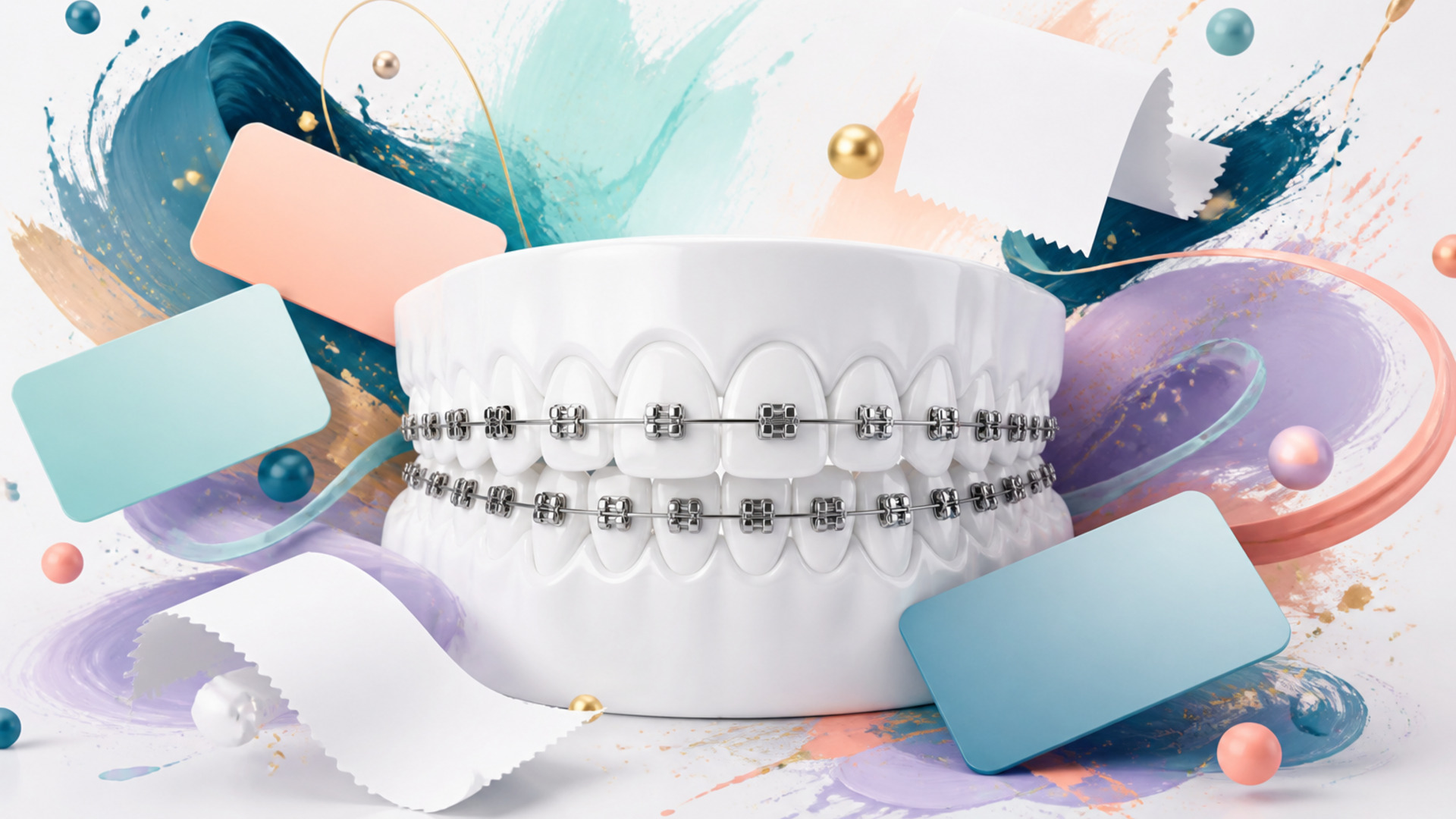
Appliance type is the visible part of the price list. Metal braces usually cost less to buy and repair. Ceramic costs more and needs careful hygiene. Self-ligating systems cost more because of design. Lingual sits at the top shelf. Material explains part of the gap inside one clinic. Between two clinics, “full package / bonding only” often exceeds “metal / ceramic.”
Public Dubai guides for 2025–2026 more often place metal near AED 5,000–12,000 for a full course, ceramic near AED 8,000–16,000, self-ligating near AED 10,000–18,000, lingual often AED 15,000–30,000+. Ad “from” figures sit below those shelves. Compare scope and package first, bracket colour second. Choosing metal on purpose saves on aesthetics. Buying “metal without a plan” saves on entry. Three material forks follow, without a brand war.
Metal as an honest budget track
Metal is orthodontics’ workhorse. It handles complex biomechanics, repairs quickly, and makes no claim of invisibility. For many adult and teenage cases it is a reasonable choice without apology. A low metal line on the estimate is fine when visits and retention sit beside it. Low metal without that list is a different product: you bought hardware, not a course.
On the metal braces service page I describe when the system fits. Here the sharper point is different: metal does not equal poor treatment. It equals lower material cost at a comparable plan. English search mixes “metal braces dubai price” with “cheapest braces dubai.” The first query is about appliance type. The second is about the market’s bottom shelf. Keep them separate, or ceramic will look like a trick and metal will look like the only quality test.
Ceramic and self-ligation: what the uplift buys
Ceramic buys a quieter look in photos. Brackets are more fragile; friction and breakage can raise unplanned visits. Self-ligation buys easier wire changes and a marketing story of “fewer appointments.” Case biomechanics outweigh the label. If someone sells self-ligation as a short-treatment guarantee, ask what the forecast rests on: your radiographs, or a supplier brochure.
Unnamed systems and brand brackets
Brand systems carry licence cost, training, and a predictable wire inventory. Laboratory or less-known systems can start cheaper. Compare obligations: availability of the wires you need, speed of replacing a lost bracket, and the doctor’s experience with that system. The logo on the box is secondary. An unfamiliar brand in experienced hands is often safer than a loud brand in a volume flow without a plan.
How to read “from AED” and build a comparable estimate
Below is the dense tradeoff table I use when a patient puts two screenshots on the desk and asks who is “more honest.” Honesty lives in the lines, not in the emotion. Figures in the market-orientation column are open 2025–2026 ranges, not my fee schedule. Your invoice is fixed only by a dated written proposal.
| Price-cut lever | What usually gets cut | What that means for you | Question before deposit | Market orientation (AED, 2025–2026) |
|---|---|---|---|---|
| Entry “from” | Full scope, both arches, visits | You compare a deposit with a course | Is this bonding or a full package? | Ads: from 299–999; metal course: 5,000–12,000 |
| Doctor role | Specialist hours at every visit | Different plan density and finish | Who leads the whole course by name? | Specialist consult: 200–600 |
| Diagnostics | OPG / ceph / plan / file copies | Plan on guesses, or pay later | Which images are included and stay with me? | Records package: 500–2,500 |
| Visit frequency | Number of activations in the package | Drift risk, extension fees | How many planned visits are included? | Interval often 4–8 weeks |
| Repairs | Rebond allowance | A bill for every debond | How many repairs are included? | Beyond limit: often 100–300+ per episode |
| Scope | One arch / “smile zone only” | Occlusal mismatch, second stage | Both arches or smile zone? | One arch cheaper; full course another range |
| Retention | First retainers | Relapse after a “cheap” finish | Retainers in package or separate? | 400–1,200+ per arch / set |
| Material | Metal instead of ceramic / lingual | Visibility vs material cost | Do I accept visible metal? | Metal below ceramic and lingual |
Read the table left to right. Name the lever the clinic used to lower the figure. Then decide whether you accept the consequence in the third column. If you do, a budget course can be a rational choice. If you do not, look for another package composition, not for “different metal magic.”
On consultation I help build one page: scope, doctor name, diagnostics, visit count, repair limit, debond, retention, and estimate validity in AED. Without that page, two Google ads are incomparable. With it, they are comparable even when entry prices differ. A practical move: print two estimates and highlight lines missing from the neighbour. The AED gap often sits in absent lines, not in clinic “greed.” If reception refuses written inclusions, you are bargaining in the dark.
One more layer is the estimate date. In Dubai, promotions and “from AED” lines live a short life. A figure without a validity window can vanish or rise a month later. Ask for the date and the validity of the AED corridor. AAO reminds patients that an accurate fee estimate follows individual evaluation. An online calculator and a banner do not replace that.
When a budget course is an honest choice
Cheap braces in Dubai are not a trap by default. They are a set of tradeoffs. The honest budget scenario I recognise looks like this: metal system, both arches when both are needed, full diagnostic minimum, clear lead doctor, visits on a schedule, retention on the estimate, goal locked in writing. The patient knows the savings sit on bracket aesthetics and boutique service, not on the plan.
Another honest scenario is a short local stage: preparation for prosthetics, closing a space after extraction, correction after trauma. Here a lower sum reflects narrow scope. Trouble starts when narrow scope is sold as “full bite correction.” A year later the person returns angry about a promise of “everything,” while the contract said “align smile zone.” Read the goal before the deposit.
A third scenario is a family with limited cash and a teenager. Instalments and monthly payment often feel safer than a giant “from” with holes. Ask for the course total, not only the first payment size. A first payment of AED 1,000 against a AED 10,000 course is a normal cash-flow design. A first payment of AED 399 against an unknown total is a wager. UAE insurance covers orthodontics unevenly: check your own booklet; I do not paste other companies’ tariffs. If no orthodontic line exists, a budget full package with clear inclusions often beats waiting for “insurance will pay later.”
Clinic geography is part of the tradeoff too. Rent in Marina and Downtown runs higher; entry “from” ads appear more often for other districts. District explains part of the price. It does not cancel questions about the doctor, radiographs, and retention. Taking the metro to a clear package can cost less than paying for a view without a plan, and the reverse also happens: a view without a plan.
I am calm about metal, about sparse but justified visit intervals, and about a clinic outside a glossy postcode. I stay calm while the patient sees the tradeoff and chooses it with open eyes. I stop the conversation when a low price rests on skipped radiographs, an anonymous “someone will place it,” a verbal “we’ll figure it out later,” or a result promise without examination. Orthodontics is a YMYL field: without an exam I do not diagnose online and I do not promise a timeline.
If you already started and the package feels like it is drifting, gather images and the estimate and take a second opinion before a radical appliance change. Switching clinics mid-course is possible, but it needs data transfer and a biomechanical reset. Settling doubt on paper costs less than a second bonding. Before you switch, ask for current photos, a panoramic film, and a plan copy: without them the new doctor starts nearly from zero, and the “saving” dissolves into repeat diagnostics.
Frequently asked questions about cheap braces in Dubai
Below are answers I give most often when someone brings a “from AED …” screenshot and asks whether to trust the figure. Questions stay short: that is how people type them into search. Answers describe tradeoff mechanics, without other clinics’ price lists and without result guarantees. Only examination, radiographs, and a written estimate fix the sum for your case. If this text and your dated contract disagree, the contract wins.
Why does Google show braces “from AED 399” while guides start near five thousand?
Because “from” more often describes entry: bonding, a deposit, or a promotion. Guides for 2025–2026 describe a full metal course nearer AED 5,000–12,000. Compare like with like: both arches, visits, debond, retention. Without a line list, the SERP floor and the guide mid-point talk about different products.
Can I save by choosing metal braces only?
Yes. Metal material usually costs less than ceramic or lingual hardware. The saving is honest when the package is complete. If the clinic cuts diagnostics and visits, you are saving on control, and metal is beside the point. Lock scope and inclusions first, then choose bracket colour on metal braces.
Is it unsafe if a non-specialist places the braces?
Risk depends on that doctor’s competence, case complexity, and clinic privileges under DHA, not on one ad line. For a complex bite I recommend a plan with a specialist orthodontist. For a narrow simple stage, examination decides. Check the licence and ask who leads the course by name before the deposit.
What happens if I skip radiographs “to keep it cheap”?
The plan rests on incomplete data. Risks include wrong assessment of impacted teeth, skeletal pattern, or bone volume; later appliance change; repeat diagnostics at your cost. The minimum set for your case should sit in the estimate before installation. Keep file copies yourself.
How often should I attend activations on a budget package?
A common orientation is every 4–8 weeks; the plan sets the exact rhythm. Less frequent visits can fit predictable stages and some systems. Too sparse a schedule on a complex case raises drift risk. Planned visit count and unplanned visit fees belong in the contract.
Are retainers included in a “cheap” package?
Often not. The first retainer set in open market orientation sits near AED 400–1,200+ per arch or set and drops out of ad “from” lines easily. Without retention, the result drifts. Ask about retainers before debond, not after the “no metal” photo.
Is it worth travelling to another emirate or to Turkey for a lower price?
Inter-emirate and international travel every 4–6 weeks is a separate budget of time and missed-visit risk. Sometimes that is rational. Sometimes a clear Dubai package with instalments costs less in full. Count course total plus transport and downtime, not one entry figure.
How do I book, and what should I bring to consultation?
Book an orthodontist consultation. Bring existing radiographs, prior notes, estimate screenshots from other clinics, and the question list from the table above. At the visit we review the clinical picture and the package contents. Method, timeline, and exact fee come only after examination and records, without online diagnosis and without a fixed result promise. If you already hold a written plan and doubt it, take a second opinion with the same data.