Choosing a braces system is not a vote for the prettiest Instagram close-up. You match three things: the bite problem, how you live for the next 12–24 months, and the package budget. I practise in Dubai as a specialist orthodontist. On consultation I lock diagnosis and goals first, then material and side of bonding. Soft floors on my service pages: metal from AED 15,000, ceramic from AED 19,000, sapphire from AED 22,000, self-ligating from AED 17,000, lingual from AED 27,000. Those are package entry points, not a final invoice for your mouth. Below I map the comparison axes, when each type fits, and which questions to ask before you sign. There is no better/worse league table here — only fit to case and lifestyle.
The axes that actually separate systems
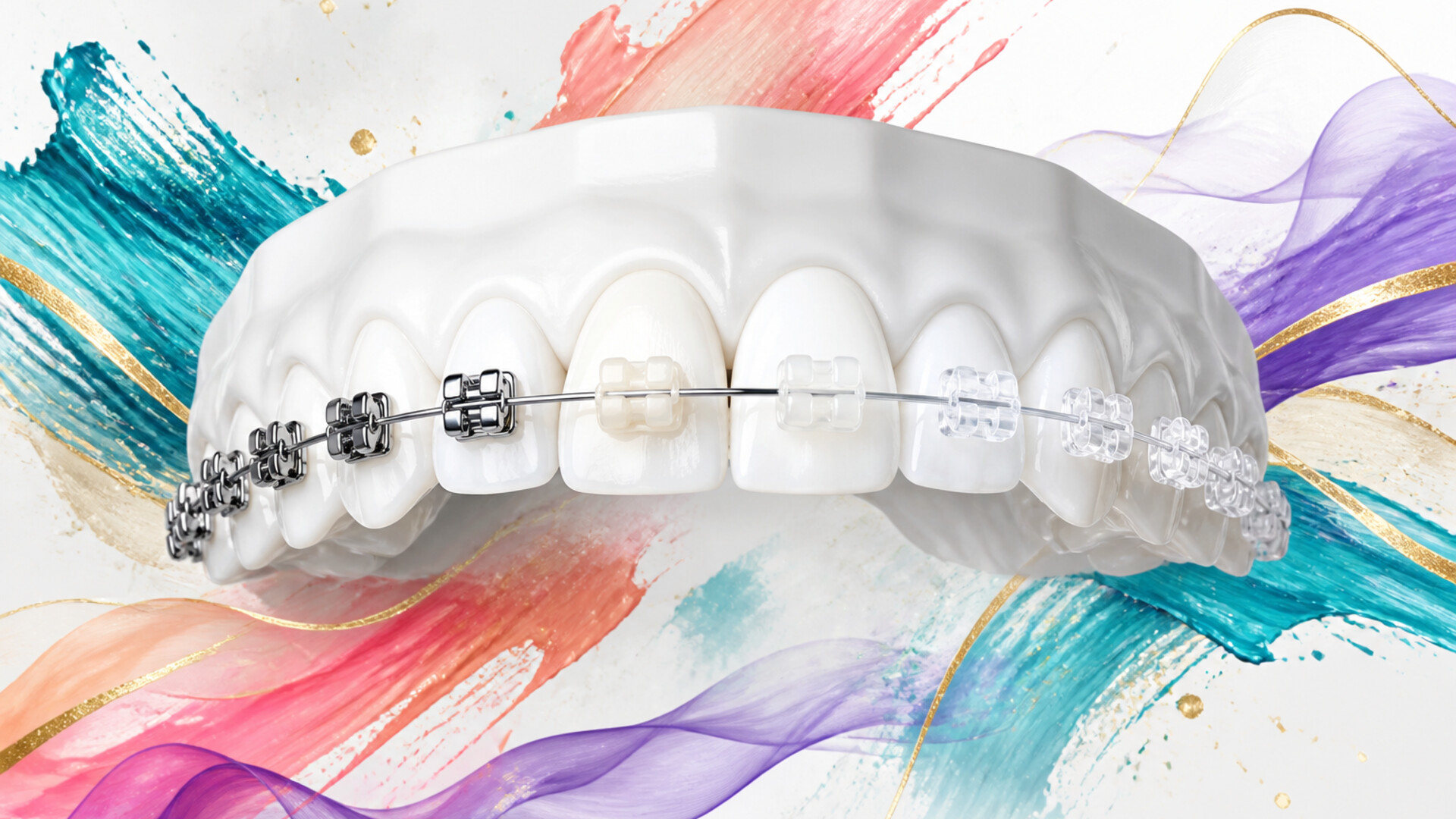
Patients often drop five brand names on the desk and wait for one winner. I split the talk into axes first. Bracket material — metal, ceramic, sapphire — answers visibility and fragility. Bonding side — outer (labial/buccal) or inner (lingual) — changes speech, hygiene, and lab workflow. How the wire is held — elastomeric or wire ligatures versus a self-ligating clip — changes visit rhythm and friction feel, yet it does not cancel bone biology. Axes cross: ceramic can be self-ligating; metal can be lingual. If you only compare bracket colour, you compare a shop window, not a plan. The American Association of Orthodontists ties appliance choice to a full evaluation, not a smile in Stories. On consultation I say which axes are hard for your case and which are open to compromise.
Bracket material and what a smile shows
Metal catches light and reads from two metres away. Ceramic sits closer to enamel colour and softens on mid-range photos. Sapphire is clearer and reads as a glass dot on the tooth; camera flash often shows sparkle more than matte ceramic. Ligatures change the picture: a dark elastic on metal is a bold accent; a clear elastic on ceramic is quieter. If your job is camera five days a week, aesthetics become a clinical tolerance factor for the whole course. If you work masked in a lab and rarely film a smile, visibility weighs less than strength and cleaning. I ask for two or three work photos: Zoom, stage, headshot. Those frames decide whether sapphire’s optical look is worth the step up from ceramic on the front teeth.
Bonding side: outside or inside
Labial braces sit on the cheek side. Lips and cheeks adapt in days or a couple of weeks. Lingual brackets sit on the tongue side: the tongue hits hardware on speech and swallow. For some patients that is a fair price for an outward-clean smile. For speakers, singers, and people with a sensitive tongue, adaptation is heavier and longer. I do not sell “invisibility at any cost”: if you negotiate in three languages and need crisp diction in month one, lingual needs an honest buffer talk. An outer system leaves the tongue freer and puts the brackets in the smile. Side of bonding is a choice about which surface of face and speech you hand to the appliance for the course.
Ligatures versus a clip
Classic brackets hold the wire with an elastic or a thin wire ligature. Self-ligating brackets use a lid or spring clip. The clip shortens wire changes in the chair and changes friction. Marketing often promises “months faster.” I promise something else: a different activation protocol and sometimes fewer elastic changes. Course length still follows biology, movement difficulty, and show-up discipline. Self-ligation comes in metal and aesthetic versions; it is a wire-holding axis, not a separate “best” brand. If you want less chair time tying elastics, a clip helps. If the case needs frequent wire bends and tight control, classic ligation stays a working tool. We lock the choice in the plan, not in a slogan.
One more axis patients forget until week one: bracket profile height. Low-profile metal often rubs the lip less than a tall aesthetic bracket with a bulky lid. I let you handle samples on consultation. The “metal in the mouth” feel differs by system, and lip adaptation is faster where the profile sits lower. That is geometry to try before you pay — not a quality ranking.
Metal braces: when they fit the case
Metal braces remain the workhorse contour in orthodontics. Stainless steel or cobalt-chromium gives a strong bracket, a predictable slot, and a wide wire library. Floor in my practice: from AED 15,000. For complex moves, teens with high debond risk, and adults who value strength over discreet looks, metal often becomes the base of the plan. I place it because mechanics and durability match the task — not because it is “the cheap option.” Visibility is a cost you accept with open eyes. Metal is not an “outdated” leftover from aesthetic ads: it is a tool with straightforward repair, common supplies, and high tolerance for everyday slips. I still offer it to camera-facing adults when the case is stiff and strength outranks shine. Three scenes where I offer metal first or nearly first follow.
Complex bites and long movement paths
When we need large rotations, space closure after extractions, heavy finishing detail, or elastics with temporary anchorage, I want a bracket that holds the wire firmly and rarely fractures. Metal delivers that. Ceramic wings on anchor teeth in a stiff phase sometimes chip mid-course — extra visits and pauses. If the goal is predictable root control over a long path, metal removes some technical surprises. I show it on a model: this tooth will travel far; this bracket must survive a wire series. You see the logic, not a sales discount.
Sport, hard foods, and debond risk
Combat sports, contact training, ice chewing, and hard nuts raise the chance of knocking a bracket off. Metal survives impact better than ceramic or sapphire. A sports mouthguard is still required, yet bracket material is part of plan protection. Teens who forget diet rules in week one break fewer courses on metal through serial debonds. Adults with heavy travel schedules also gain: fewer emergency rebinds in another city. On consultation I ask straight about sport and table habits. An honest answer shifts the recommendation more than a wish for “no shine on camera.”
Package budget and a clear supply chain
Metal usually sits on the lower step of fixed-appliance floors on the site. That is not “cheap treatment”; it is access to full mechanics without paying for aesthetic material. Supplies are common: if you change doctor or leave Dubai, a colleague can often source wires and brackets in the same class. For an expat who may move in a year, supply compatibility is a practical plus. I record system class and slot in the contract so the next orthodontist is not guessing from a phone photo. If budget is tight and the bite goal is serious, metal keeps the clinical ceiling without cutting mechanics for bracket colour.
Allergy and sensitivity sit in the history too. Most patients tolerate medical-grade steel. Confirmed nickel allergy leads to alternate alloys or other systems — rare, yet important. Do not confuse first-week mucosa rub with allergy: wax and adaptation settle the first; the second needs a material change. I ask about reactions to earrings, belt buckles, and piercings. A short history can spare a mid-course system swap.
Ceramic braces: visible aesthetics
Ceramic braces use polycrystalline alumina or similar tooth-coloured materials. Floor: from AED 19,000. They sit on the outer surface yet read softer than metal at conversational distance. Patients choose them when the smile is on camera and they will not — or cannot — hide hardware on the tongue. Ceramic needs diet and hygiene discipline: the bracket is more brittle, and stain around wings shows sooner on a light background. I place ceramic on the full arch or only on the front with metal behind — a hybrid that often covers both aesthetics and chewing-zone strength. Before you sign, answer honestly whether you will pay for a quieter smile line and keep a stricter diet than on metal. If the answer is yes, ceramic is a working compromise, not a looks-only purchase.
Whose routine matches ceramic
Face-to-face office weeks, teaching, sales floors, a wedding six months into treatment — typical entries. You will pay for a quieter front line and you will not accept lingual speech adaptation. Ceramic is the compromise: appliance outside, without metal flash on the incisors. I warn about flash photography: a light bracket still glints. If the bar is “colleagues should not spot metal at once,” ceramic works. If the bar is “nobody should notice anything,” we talk lingual or clear aligners when trays are indicated.
Colour, ligatures, and daily care
Ceramic itself does not “yellow” like tea film on enamel, yet pigment pools around the bracket and elastomeric ligatures darken with coffee, curry, red wine, and smoking. On a light bracket that shows earlier than on metal. Clear or tooth-coloured ties change at activations; coloured ties are a teen accent choice. Interdental brushes and an irrigator around ceramic are mandatory: white demineralisation spots next to an aesthetic bracket spoil the finish more than metal shine ever did. I hand a drink note and check cleaning technique at visit two. Looks without hygiene become white scars after removal.
Fragility and rebond limits in the contract
A ceramic wing can chip on hard biting or impact. Ceramic rebinds are a common line above package limits. Before you sign, ask how many free rebonds sit in the package, the fee beyond that, and whether we keep ceramic on molars or leave metal behind. I often recommend a hybrid for that reason: looks in front, strength where load is higher. If you insist on ceramic on every tooth, we write repair risk into the estimate. That is budget clarity, not scare copy.
Ceramic on lower incisors sometimes wears against upper teeth in a deep bite until the vertical relationship opens. In those cases I often keep metal below at the start or place bite turbos on the uppers. Smile aesthetics ride on the upper; lower metal barely shows in normal speech. Patients doubt the hybrid until they see themselves talking in a mirror. Practicality beats “all brackets one colour” symmetry here.
Sapphire braces: clarity and what you pay for
Sapphire braces are monocrystalline alumina — a clear bracket. Floor: from AED 22,000. On enamel they look like glass points; many prefer that to matte ceramic. Sapphire does not mask tooth colour — it transmits light. On darker enamel or heavy staining, clarity behaves differently than on an even light arch. I place sapphire when the patient knowingly pays for that optical effect and accepts the same lifestyle limits as ceramic: careful eating, hygiene, rebond limits. “Sapphire is always less visible than ceramic” is a shortcut; under flash, sparkle can read stronger. Choice is taste and budget next to clinical fitness.
Sapphire is more brittle than metal. On the chewing group I again leave metal more often or price the risk. The archwire stays metal in most protocols: there is no fully “clear” force system with a working wire. Aesthetics live in the brackets, not the wire. Patients who dislike silver wire on sapphire sometimes ask for tooth-coloured coated wire on the front segment; coating wears and needs replacement — a separate habit and fee line. I name that before bonding so month three is not a surprise.
Who fits sapphire: an adult with even light enamel, a public smile, a budget above the ceramic floor, and no heavy contact sport. Who I steer toward ceramic or metal: mixed restorations of different shades, high debond risk, or a wish for maximum strength across the arch. The gap between from AED 19,000 and from AED 22,000 on the site is a material marker, not a promise that sapphire finishes faster. Movement plan sets duration.
I also clear the myth that sapphire whitening teeth. The bracket does not bleach enamel. If whitening is planned, it usually sits after removal and retention settle — not “under a clear bracket.” Otherwise you pay for material optics and still see the original shade through the crystal. On consultation I seat sapphire and ceramic samples on a tooth under window light and phone flash so you pick the sparkle you can live with for a year or two.
Self-ligating systems: a clip instead of ties
Self-ligating braces hold the wire with a built-in lid or clip. Floor: from AED 17,000. They come in metal and aesthetic versions. Patients arrive asking for “Damon / self-ligating because it is faster.” I separate brand from mechanics. A clip changes friction and visit protocol; it does not cancel bone density, periodontal age, or the need for elastics. In some cases activation intervals run a little wider. In others I still recall you sooner for hygiene or hard movements. The honest line: self-ligation is a convenient steering tool, not a short-course guarantee. I put a clip in the plan when activation protocol and your habits match the tool. Below is what changes in the chair, where the speed myth breaks, and whose habits match a clip.
What changes in the chair
Wire changes on a clip are usually shorter: open, seat, close. Less time tying ligatures. For a packed Dubai calendar that matters when visits stack. Hygiene checks, photos, and occlusion review still take their share. Ad “five-minute activations” rarely include the full clinical work of a visit. I book time for what the case needs, not for the clip slogan.
The speed myth
Reviews and day-to-day practice show: average duration gaps between ligated and self-ligating systems are often small when cases are matched. Any months gained, if they appear, track the doctor’s protocol and the patient’s biology more than the box label. I do not promise “six months faster.” I promise a clear activation schedule and an honest reset if progress stalls. If someone sold you self-ligation only on a speed slogan, reread the contract for what happens when the course runs long.
Whose habits match a clip
Adults who want calmer visits without monthly colour-tie rituals often like metal self-ligation. Teens who live for colour changes each month lose that ritual on a clip — set the expectation early. With aesthetic self-ligation, check bracket bulk: some lids sit taller than classic ceramic. Try the “lip volume” feel on consultation if samples are available. I tie self-ligation to a protocol I can steer, not to an Instagram trend.
One practical note: coloured elastics are not the point of a self-ligating clip. A teen motivated by colour swaps may lose drive. An adult who finds coloured rings unprofessional at work gains. I ask that without joking about “fashion colours.” Motivation to keep appointments is part of biomechanics on a long course.
Lingual braces: hidden on the tongue side
Lingual braces bond on the tongue side of the teeth. Floor: from AED 27,000. From the street the smile often looks free of hardware. For that outward clean look you pay with tongue adaptation, different hygiene, and lab workflow: many systems are custom and tied to a digital protocol. I offer lingual when outer aesthetics are a hard work or personal requirement and the patient accepts a lisp window plus more careful cleaning. This is not “premium for status.” It is a different contract with your tongue and visit calendar. Before the lab scan, we should separately cover speech, relocation, and the cancellation window on lab prepayment. If those points already sting, we look at outer aesthetics first and keep lingual as a deliberate second step.
Speech, tongue, and the first weeks
In the first days and weeks the tongue hunts for space. Sibilants and “r” sounds suffer for some people. Singers, language teachers, and lawyers on hearings need a buffer — or outer aesthetics instead. I only draft “medical adaptation” wording for an employer if you ask; usually a personal plan is enough: fewer public talks in week one–two, speech drills, wax on sharp edges. Most people adapt. A minority ask to rebond labially — better to price that risk before you fund the lab.
Hygiene and brush access
The tongue side is harder to see in a mirror. Plaque hides in contacts and toward the palate. An irrigator and superfloss are baseline, not optional. Without discipline, lingual inflames gums before a selfie shows it. At review I inspect the inner side as strictly as the outer side on labial systems. If hygiene on consultation is already weak, we fix habits before we buy expensive invisibility.
Lab work, repairs, and changing doctors
Custom lingual systems are hard for another doctor to continue without files and parts. For an expat who may relocate, that is a hard question. Ask before start: how the case transfers, whether cloud access exists, what happens if a bracket fails on a work trip. Sometimes labial ceramics or sapphire with a common supply chain are calmer than lingual with a dead end in another city. I name the trade aloud: invisibility today versus flexibility tomorrow.
Lab cost inside a lingual package usually sits above a standard labial system. Custom bases, digital setup, sometimes robot-bent wires — time and money before you feel the first bracket on the tongue. If you cancel after the scan, part of the lab fee may not return. Read the contract on lab prepayment and the cancellation window. Clarity here matters more than a banner discount on “premium invisible.”
How I close the choice on consultation
On consultation (from AED 500 on the site) the order is: complaints and goals, exam, imaging as indicated, appliance options, written estimate frame. I do not start with a bracket display. First — what must change in the bite and how long you can keep activation visits. Then — sport, speech, camera, budget, relocation. Only then I name two or three realistic combinations. Often that is metal on both arches; ceramic in front and metal behind; self-ligating metal; less often full sapphire or lingual. I do not unpack clear aligners in depth here: that is different mechanics, and when trays fit we open a separate wear-time talk.
Dubai life adds filters. Heat and takeaway coffee stain ligatures. Contact sport by the marina pool needs a guard. Frequent flights need wax stock and a plan for where to go if a bracket fails. A wedding or shoot three months after bonding pushes aesthetics at the start. I write those dates into the plan: sometimes we delay start two weeks; sometimes we pick material around the calendar, not the other way round.
Budget I split into site floors and hidden lines: rebond limits, removal, retainers, possible temporary anchorage. Comparing only metal “from” and lingual “from” without inclusions is empty. The cheaper package is the one that reaches your agreed result without endless repair fees on a fragile choice. After exam the total may sit above the floor — a complex case does not fit the lowest price line.
Three short practice portraits help people recognise themselves. First: an engineer on camera stand-ups five days a week, mild bite, no impact sport. We often land on ceramic on upper incisors with metal behind, or a full aesthetic arch if budget allows. Second: a teen in martial arts whose parents want “invisible.” I bring the talk back to a guard and strength: metal plus mouth protection keeps the plan safer than brittle looks without discipline. Third: an on-camera host who cannot show outer brackets on any broadcast. Then we unpack lingual with a speech buffer or, if biomechanics allow, aligners on a separate track. A portrait does not replace records and an exam, yet it cuts advertising expectations fast.
Another decision layer is a timed hybrid. Sometimes the first months run on metal for a heavy phase, then we rebond aesthetics on the front before a wedding or job change. That costs more than one bonding and honestly joins mechanics to the calendar. I only offer it if biology and enamel can take a second bonding cycle. I do not double-bond fragile material “for looks on day one” during a stiff mechanical phase.
Documents after you choose: goal plan, bracket type and side, slot, duration range, package floor, and what sits outside it. Without that paper, six months later memory fights “I thought we had sapphire everywhere with no extras.” A written frame protects both sides.
One table: systems side by side
Below are working practice floors (from … on the service pages) and lifestyle axes. Figures are package entry points, not an offer for your mouth. Duration and visit count follow the case; the table carries no “faster” promise.
| System | From AED | Outer visibility | Typical lifestyle fit | Check before you sign |
|---|---|---|---|---|
| Metal | 15,000 | High | Strength, supplies, complex moves | Can you live with shine on camera |
| Ceramic | 19,000 | Lower than metal | Meetings and photos | Fragility, ligatures, rebond limit |
| Sapphire | 22,000 | Clear sparkle | Glass look on light enamel | Flash glare, fee, chewing teeth |
| Self-ligating | 17,000 | Follows bracket material | Clip, different visit rhythm | No guaranteed shorter course |
| Lingual | 27,000 | Minimal | Smile without outer brackets | Speech, hygiene, lab, relocation |
| Consultation | 500 | — | Decision point | Credit into package if you start? |
Map your week against “visibility” and “lifestyle fit.” If camera outranks strength, look at ceramic, sapphire, or lingual. If strength and relocation outrank the frame, metal or self-ligating metal. If you need a middle path, hybrid by arch zone. We lock the choice after diagnosis — not from a blog table alone.
The table also fails as a substitute for exam because the same “metal from 15,000” on the site is a package floor, while your mouth may need extractions, temporary anchorage, a long finish, or a mid-course goal change. Then the estimate rises for any bracket material. Material answers visibility and fragility; orthodontic workload answers the diagnosis. Ads that sell “the most invisible braces” without naming bite complexity mix those layers on purpose.
FAQ
How do I choose braces if I want both discreet and fast?
Discreet and fast are different bills. Speed follows biology and movement volume; discreet follows material and bonding side. I match the system to your case and your tolerance for visibility, without promising that sapphire or a clip will cut half a year by themselves. On consultation I give a realistic duration corridor for your goal.
Can I have ceramic only on the upper front teeth?
Yes. A hybrid — aesthetics in front, metal behind — is a common working setup. It softens the smile line and keeps strength on chewing teeth. We match shades and ligatures so the transition does not shout on photos. The estimate follows the real mix of brackets.
Are sapphire braces always less noticeable than ceramic?
No. On even light enamel sapphire often looks more “glass-like.” On stained enamel or under hard flash, clear sparkle can read more than matte ceramic. Pick optics with samples on the tooth in daylight and under phone flash.
Do self-ligating braces really finish faster?
Not as a rule for everyone. A clip changes friction and chair convenience; matched-case reviews do not show a stable multi-month win from the lid alone. Ask about activation protocol and progress criteria, not brand slogans.
Who should not start with lingual braces?
People with a very sensitive tongue, hard diction demands in the first weeks without a buffer, weak hygiene, and likely relocation without access to the same lab system. In those scenes I more often offer outer aesthetics or metal with a clear supply chain.
Does the braces system change how long I wear retainers?
Bracket type hardly sets retainer duration. Retention follows result stability, growth in teens, periodontal health, and wear discipline. After any course you need a retainer plan; budget it apart from braces “from” prices.
What matters more for the result: bracket brand or the doctor’s plan?
Plan, records, and visit control. A good bracket in a weak plan will not save the bite. I choose a system I can steer in your case and write goals down. Brand without protocol is buying packaging.
How should I prepare for a consultation on system choice?
Bring priorities: camera, sport, speech, budget, relocation, wedding or public dates. Bring recent radiographs if you have them, plus a medication list. On the visit we join those points to appliance options and estimate floors. I do not assign a system from photos online.