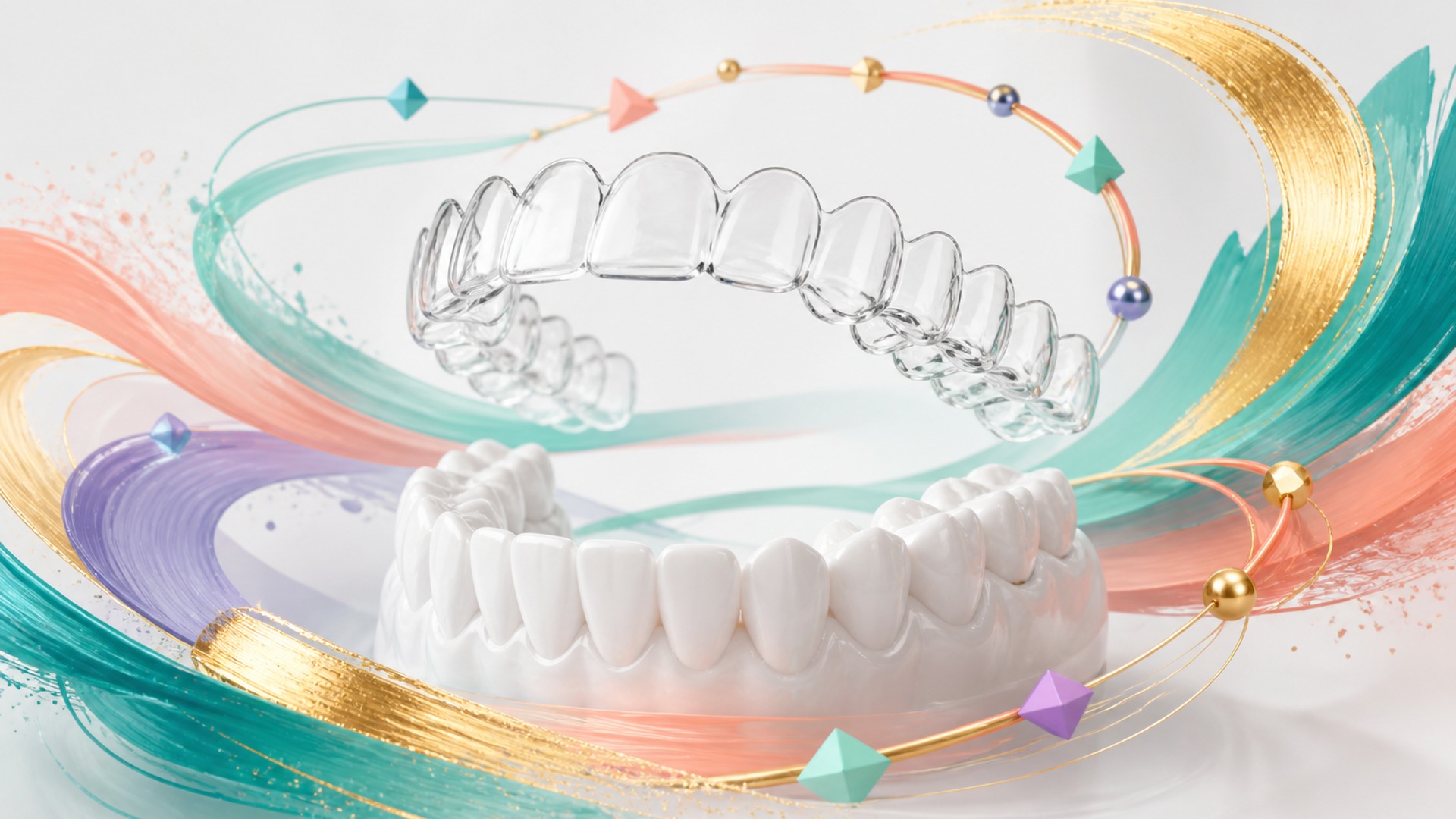
On screen, teeth slide into a neat row in thirty seconds. In the chair the same path takes months, and the finish rarely copies the last frame of the clip one for one. A clear aligner 3D plan is a movement map: how many trays, in what order, where attachments sit, where enamel reduction goes, where elastics join. The simulation helps you agree a goal. It does not sign a contract with your bone. I practise in Dubai as a specialist orthodontist, and on consultation I walk the plan with you before you pay for a full series: what the screen shows, what it hides, which edits I already made, and why a “pretty clip” is still not the result. Below is how to read a simulation without marketing fog, which questions to ask before approval, and which service floors to check on the site: an aligner treatment plan from AED 600, 3D bite modelling from AED 1,500, digital treatment planning from AED 5,000. Only an exam and a written estimate settle the course total.
What a 3D plan is in the chair
Patients use different labels for the same thing: ClinCheck, “the movie,” “smile design,” “3D.” Clinically a 3D plan is an agreed model of the path from today’s tooth positions to the target, cut into stages. Each stage later becomes its own tray. The plan grows from a scan (or impressions), photos, radiographs, and the doctor’s decisions. The lab or brand platform offers a draft. The orthodontist edits order, step size, and auxiliary mechanics. Only after your signature (or clear chart consent) does manufacturing start. Without that layer you buy plastic built on someone else’s hypothesis. With it you buy a course under the doctor who approved the plan.
Keep 3D bite modelling and full digital treatment planning separate in your head. Bite modelling locks arch geometry and helps show a setup. Digital planning is wider: goals, alternatives, risks, sometimes braces versus trays. The aligner treatment plan line on the site is the floor for aligner-specific logic and simulation under the chosen system. The three services do not copy each other and need not share one package price. Ask what is already paid before the first tray.
Lab draft and doctor edits
A draft often looks “already fine”: even front teeth, short timeline, few attachments. A pretty draft is a starting point, not the finish. I check whether steps on round premolars are too large, whether space exists without unrealistic expansion, whether a root on screen is asked to travel past a sensible limit, and where the simulation hides hard rotations. Edits take time. Two or three rounds with the platform are normal. Approving the first auto-setup for speed is a common reason tracking fails three months later.
In the chair I show before/after and key mid-path frames. If you only see a final smile without stages, ask for the full run. A finish without a path looks like an ad, not a treatment plan.
Approving a plan is not buying a miracle
When you approve a plan, you agree the movement logic, the volume of auxiliaries, and the package level (tray count and how many plan-revision rounds sit inside). You are not buying a legal guarantee that the last simulation frame will match your mouth in a year. The American Association of Orthodontists describes tooth movement as a biological response to force. Biology does not co-sign next to you. So in the contract look for extra-series limits, rules when tracking drifts, and what an adult aligners or Invisalign package includes — not the line “result as on screen.”
What feeds the simulation before the first frame
A simulation is only as strong as its inputs. A weak scan, an old panoramic film, and a phone photo at a bad angle still produce a pretty, soft model. I build layer by layer before I play the “future smile” clip.
Scan, photos, and radiographs
An intraoral scan captures crown surfaces and the gingival margin in the zone of interest. A photo protocol locks face, smile, and occlusion aesthetics for later comparison. A panoramic film and, when needed, a lateral cephalogram show roots, impacted teeth, and skeletal background. I order CBCT only with an indication. Without bone on imaging, the on-screen plan answers “where crowns move in the model,” not “is there bone volume and any root surprise.” If you bring records from another country, I check date and quality: a three-year blurry OPG saves little.
Goals you say out loud
“I want straight teeth” sounds simple and lands poorly in a plan. You need detail: midline, gum display, overbite, buccal corridors, readiness for enamel reduction, readiness for attachments, priority of speed versus predictability. I write goals down before I edit staging. Otherwise six months later “straight” also meant closing a gap at a second molar that was never in the plan. A mid-course goal change is a separate talk about volume and package, not a free tweak inside the same box.
System choice and package level
Invisalign, ClearCorrect, StarSmile, and other certified systems share a similar path: scan → plan → manufacture → reviews. Interfaces, options, and package rules differ. A short tariff under a full-course task almost always cuts the simulation or forces an upgrade. On the plan I tie on-screen stage count to the tray limit in the estimate before the lab order. If the clip shows 36 stages and an “Express” tariff cuts at 14 trays, it is too early to sign.
How to read the simulation on screen
Plan review is its own slot, not five minutes at the end of a consult. I pause the clip, rotate the model, and point at specific teeth. Below is a vocabulary for what to watch even when the brand interface differs.
Stages and tray count
Each frame / number is a separate tray geometry. More stages are not always “worse”: finer staging on hard teeth is often more predictable than a short aggressive clip. Ask how many upper and lower trays; whether some stages are one-arch only; whether pauses or “passive” trays are built in. Course calendar roughly equals stage count × wear time per tray (often 7–14 days by protocol) plus manufacture, shipping, and reviews. That is a corridor, not an ad deadline.
Attachments (composite buttons)
On the model they look like coloured or translucent bumps on crowns. In life they are tooth-coloured composite. They give the tray grip and help deliver force for rotations, extrusion, and root control. If the simulation puts many attachments in the smile zone, I say early how they read up close and under flash. A request to “remove every bump” changes biomechanics: the plan must be recalculated, not just wiped from the screen. A separate article covers day-to-day attachment life; here the point is simpler: attachments on the simulation are mechanics, not a beauty option.
Enamel reduction (IPR)
On the plan, IPR often appears as narrow gaps or marks between contacts with a millimetre or fraction figure. It is controlled removal of microns of enamel to create space for crowded teeth. Ask where, how much in total, and at which stage of the course. Refusing both IPR and expansion often breaks the space maths. Then we change the goal or change the tool.
Elastics, buttons, mini-screws
Inter-arch elastics do not show equally clearly in every brand viewer, but the written plan must name them: pattern, hours, which teeth. Without elastics a tray weakly solves some Class II/III and midline tasks. Mini-screws are a separate risk talk. If the doctor shows only an “even front” and stays silent about elastics you will receive on visit three, you read an incomplete plan.
The final frame: what it promises and what it does not
The final frame promises target crown positions in the model under ideal tracking and protocol compliance. It does not promise identical gum photogenicity, no “black triangles” after closing spaces, perfect enamel shade, or that neighbouring restorations will “catch up on their own.” Periodontium, crown shape, and old fillings stay yours. Orthodontics moves teeth; veneers and whitening are other services if they are needed at all.
Overcorrection, passive trays, and hidden stages
Some plans push the last trays slightly past the clinical target — overcorrection to offset expected shortfall. On screen the finish looks a touch different from the goal we named in the chair. I say that out loud: “here the model goes a little farther; in the mouth we stop earlier.” Without that line, patients compare the mirror to the last frame and decide the course “wasn’t finished.”
Passive or near-passive stages sometimes hold a position already reached while a neighbour catches up, or wait for elastics. Tray count rises while work on a given tooth is almost nil. That is not fee trickery. It is a pause in mechanics. Ask which numbers are active and which are holding.
Colours, arrows, and heat-style maps
Platforms colour teeth by movement size, draw vector arrows, or highlight risk zones. Colour is not a diagnosis. I translate the scale into chair language: this premolar rotates N degrees over the course — expect attachments and possible lag; this incisor tips lightly — usually calmer. If an assistant scrolls the clip without pausing on the coloured teeth, ask to stop on those. Coloured zones are your question list, not interface decoration.
| On-screen element | What it means in the mouth | Ask before approval | Common surprise if you skip the ask |
|---|---|---|---|
| Stage count | Tray count and rough calendar | How many trays / wear time per tray | Short package under a long simulation |
| Attachments | Composite bumps on enamel | Where, how many, can the set shrink | “I never wanted bumps on photos” |
| IPR | Separation between teeth | Where and how many microns total | Refusal breaks arch space |
| Elastics | Inter-arch pull by the hour | Pattern and discipline | Elastics “suddenly” in month three |
| Arch-form expansion | Teeth move buccally / labially | Bone and smile-aesthetic limits | Protrusion nobody expected |
| Final smile | Target crowns in the model | What may still need a plan revision | Disappointment “not like the clip” |
What the simulation does not show
Patients get angry at a plan when they expect from the clip what the file never held. It is calmer to know the blind spots early.
Roots and bone volume
Most consumer simulations draw crowns. Root torque and position in bone the doctor reads from radiographs and experience, sometimes with CBCT overlays in professional modules. A pretty crown tip on screen can hide a risk I see on a cephalogram. So I stop a plan when a root already sits against a thin bony plate and the simulation wants to push the smile farther forward.
Periodontal response and bone speed
The model does not know if you smoke, how gum heals after hygiene, or how fast adult bone answers force. Two patients with similar clips diverge by months. AAO ties movement to biological response. The simulation sets direction. Tissue sets pace.
Your wear hours
The plan assumes about 20–22 hours of contact a day in a typical protocol. The simulation does not bake in “coffee without trays five times a day” or a two-week holiday with empty trays. Hour gaps show up at review as a lagging tooth and “bad plastic.” Plastic is often not the culprit.
Soft-tissue aesthetics
Gum levels, papillae, and lip asymmetry on smile are shown roughly or not at all. After crowding resolves, “black triangles” sometimes appear — space at the gum from crown shape and papilla loss. That is anatomy, not a lab bug. I name the risk before start, especially with heavy adult front crowding.
Why the simulation is not a result guarantee
Short answer: the plan is a path hypothesis under doctor control. The hypothesis updates when the mouth answers differently. The longer answer sits in the layers I name on consultation before the deposit.
Platform autopilot and the orthodontist’s hand
Some clinics show patients a nearly untouched lab draft. Others show a plan after several specialist edit rounds. The difference for the mouth is large. Autopilot optimises the picture and the timeline. The doctor optimises predictability for your periodontium, wear hours, and goals. Half of expectation hangs on “who approved the final.” In Dubai, DHA framing adds that a specialist works within specialty and clinic privileges. I do not sign a simulation I am not ready to follow with reviews.
Staging is optimistic by nature
Software and labs try to fit the path into a sensible tray count. Larger steps make a shorter clip and raise the chance a tooth will not arrive. I often lengthen the first series on hard movements to cut early tracking loss. Patients need an honest time corridor, not a promise “like the story in three months.”
Predictability differs by movement type
Crown tipping and relative intrusion come more readily to a tray. Heavy rotation of round teeth, extrusion, bodily translation, and root-torque control need attachments, fine staging, and more often a plan revision. If your clip is dominated by hard movements, I name the chance of an extra tray series before payment, not after “why isn’t it like the screen.”
Reviews catch drift before the box ends
Tracking is the match between the mouth and the plan stage. At review I compare tray seat and photos with simulation frames. A gap at an incisor, a floating tray, an attachment that will not click — signals to fix now: finish the stage, drop back a tray, rebuild composite, or scan for a plan revision. Waiting for the last tray “just in case” costs more. A separate article covers plan revision and course extension; here the link is from screen expectation to visit rhythm in Dubai, where flights easily erase a review.
Plan revision is a standard tool, not a scandal
A new scan and an extra tray series close what the first series did not finish. In ads that sounds like a defect. In a full adult course it is a common finishing tool. Look for round limits in the package contract. An aligner treatment plan from AED 600 on the site is the floor for rebuilding logic when a fresh written outline is needed; a full system package sits at other service-page numbers.
Questions worth asking before you approve the plan
I walk this list myself when politeness keeps a patient quiet. Write the answers down or ask for a short note after the visit.
- How many upper and lower trays sit in the version we are approving?
- What wear time per tray do you set at the start?
- Where are the attachments, and can part of the set safely come off?
- Where is IPR, and what is the total volume?
- Are elastics needed, from which stage, and how many hours a day?
- Which movements in the plan do you rate as least predictable?
- How many plan-revision rounds sit in my package, and what sits beyond the limit?
- Who personally approves the final — an orthodontist or another dentist?
- When is the first review after fitting, and what should make me message sooner?
- What happens to the plan if I travel 3–4 weeks without a visit window?
If answers to several items are “we’ll figure it out later,” it is too early to approve manufacturing. Clarity costs less than a rescan born of broken expectations.
Money: what you pay at the plan stage
Some clinics show a simulation “free” as a sales funnel. Others bill it as its own line. Floors on my site look like this; the exact estimate comes only after exam.
| Service | Why it exists | Site floor | Clarify in the estimate |
|---|---|---|---|
| Consultation | Exam, tray fitness, fork in the plan | from AED 500 | Credit into package at start |
| 3D bite modelling | Digital model / setup | from AED 1,500 | Included in an aligner package? |
| Digital treatment planning | Full goals and alternatives | from AED 5,000 | How many edits before approval |
| Aligner treatment plan | Aligner simulation and stage logic | from AED 600 | Do you see the clip before paying for trays |
| System package (Invisalign and others) | Trays, attachments, reviews by level | from AED 22,000 (Invisalign); other systems have their own floors | Tray and revision limits, retainer |
Comparing two clinics on a “free ClinCheck” is empty if one package includes a plan revision and a retainer and the other includes only the first box. Dirty total: diagnostics + plan + package with one likely plan revision + retention. A pretty clip without those lines is advertising, not an estimate.
After approval: live with the plan, not the clip
Approval does not mean “never look at the model again.” At reviews I return to key frames: where teeth should sit on this tray number. At home you can use a simpler check: the tray seats fully with a clear contact on attachments and without a lasting gap on key teeth after chewies. If a gap holds for days with honest hours — message me. If the gap appears at 14 wear hours — fix hours first, then panic about a “bad plan.”
Keep a copy of the approved plan or brand patient-portal access if it exists. On a move or when continuing adult aligner care in another city, 3D-plan access saves weeks of digging. Case number, remaining tray list, and revision history belong in medical transfer, not as a “lab secret.”
Flights, Ramadan, and long gaps without review
Dubai is a travel city. The on-screen plan assumes regular visits. If you fly for a month with a box of trays “ahead,” agree in advance: up to which number you go without an exam, what to do if a gap appears, where to send seat photos. Blind progress through the box on a trip is a common reason to need a plan revision earlier than the clip suggested. In Ramadan and when meal patterns shift, wear hours also drift: trays come out more often and longer. I fold that into the calendar talk before approval, not after the complaint “the plan is lying.”
Changing the goal after tray five
Sometimes two months in you want a task that was never in the simulation: close a more distal space, straighten a second premolar “while we are here,” pull the midline harder. New volume can exceed a short package limit. Then we recalculate and maybe upgrade — we do not call it a tiny tweak inside the same box. Better to say that at the start than to stockpile disappointment toward the final frame.
Retention after the last tray is often drawn weakly or not at all on the simulation. Discuss retainers in the same talk where you approve the final frame. Otherwise the brain plants a full stop on the “pretty clip,” and teeth start the reverse path without an appliance.
How I walk a plan in the Dubai chair
The slot is longer than a “quick scan for stories.” First goals and limits: wedding or relocation dates, readiness for attachments and IPR, sport, bruxism, periodontium. Then current records and a scan. Then the draft and my edits on screen with stops on hard teeth. Then stage count checked against the adult aligners or Invisalign package level. Then written answers to the question list above. Only then — manufacture. If you came “just to see the movie” without radiographs, I can show the technology, but I will not approve a clinical plan. A pretty clip without bone and periodontium is entertainment, not treatment.
A second opinion on someone else’s already-approved plan also happens. Then I compare the simulation with today’s mouth: tracking, hygiene, realism of remaining stages. Sometimes the course can finish. Sometimes it is cleaner to stop and rescan. I do not verdict from a WhatsApp screenshot without the chair: camera angle lies harder than any ClinCheck clip.
Common questions about the 3D plan and simulation
Below are questions I hear before plan approval and that people type into search: what a clear aligner 3D plan is, whether ClinCheck is mandatory, why the simulation diverges from the mouth, whether you can edit the plan, whether it sits in the fee, whether the final frame is a guarantee. Answers are short; a personal read still needs an exam and records.
Is the on-screen simulation a guarantee of the result?
No. It is an agreed path hypothesis under protocol compliance and doctor review. Mouth, bone, and wear hours add corrections. The final frame is a model goal, not a legal photo guarantee a year later.
Must I review the full 3D plan before I pay for trays?
Yes in sound practice. Without stages, attachments, and IPR you do not know what you are buying. I do not send a series to manufacture until goals and mechanics are agreed. “Just make it pretty” is a weak lab instruction.
Can I ask to remove attachments or IPR from the plan?
You can ask. I recalculate risk and sometimes offer alternate staging or another appliance. Wiping elements from the screen without a recalculation leaves a pretty, weak model.
Why did a friend’s case “match the movie” while I am told about a plan revision?
Cases differ in biomechanics and discipline. A short aesthetic front more often sits close to the clip. A full adult course with rotations and inter-arch tasks more often needs an extra series. Comparing someone else’s finish to your screen before start is early.
Is the 3D plan included in an Invisalign or other system package?
It depends on the clinic and tariff. On my site an aligner treatment plan is from AED 600, 3D bite modelling from AED 1,500, digital treatment planning from AED 5,000; some lines may credit when a package starts. Ask for a line-by-line list before the deposit.
How many times can we edit the plan before approval?
Confirm in writing. Two or three clinically useful rounds are common. Endless polish “for the wedding photo” without medical need stretches time to start. I stop edits when mechanics and your goals match, not when filter wishes run out.
Can I approve a plan online by chat?
I do not set a full orthodontic plan without an exam and current records. A draft second-opinion read of radiographs can fit a defined service, but I do not launch series manufacture without the chair and periodontal status. In Dubai, specialist licence and responsibility sit on top of that rule.
What if I already approved the plan and change my mind before trays arrive?
Message the clinic at once. Cancellation is simpler before the lab starts. After manufacturing begins, refund rules follow the clinic and brand contract. Earlier signal means fewer lost fees and less wasted plastic.
What if I travel 3–4 weeks without a visit window?
Agree in advance which tray number you reach without an exam and where to send seat photos if a gap appears. Blind progress through the whole box on a trip raises plan-revision risk. Sometimes it is wiser to stay on the current tray and return for review right after landing.
How is an aligner 3D plan different from “just a 3D bite model”?
Bite modelling locks arch geometry and helps show a setup. An aligner treatment plan adds tray stages, attachments, IPR, elastics, and manufacture logic for the chosen system. Digital treatment planning is wider than both: goals, alternatives, risks, sometimes a braces comparison. Ask which service you are buying under the word “3D.”
Read a 3D plan as a working map: stages, attachments, space, elastics, revision limits. The simulation helps you choose a goal and see the price of discipline. It does not replace biology or cancel reviews. If you want your clip read this way, start with a consultation and records — not a rushed signature under the last frame.