Behruzoglu Orthodontics
Diet in Orthodontics

Diet in Orthodontics

After installing braces, we ask very little of our patients. There are mainly two rules they must follow:

  1. Cleaning (we will talk about this later),

  2. Diet.

Before we move on to what and why you should not eat and drink while you have braces in your mouth, I want to explain why this is so important.

We attach the braces to the teeth with a special composite. Since the braces are the very particles that transmit the forces applied by the orthodontist to the teeth, we of course want them to hold firmly onto the teeth. From the point of view of the duration of pressure on the teeth, it is very important that the braces stay on the teeth throughout the entire treatment, otherwise this negative factor will affect the course, result, and duration of the treatment. But, on the other hand, they will have to be removed at some point, and in doing so, we must not harm the tooth enamel.

And these moments leave the orthodontist face to face with a difficult question: how to attach the braces so that they stay on the teeth during the treatment and are easily removed at the end?

There is no answer to this question yet. Therefore, patients must take care of their braces during treatment.

And here the second question arises, how can they do this? This is where the diet in orthodontics comes into play.

The diet consists of two parts:

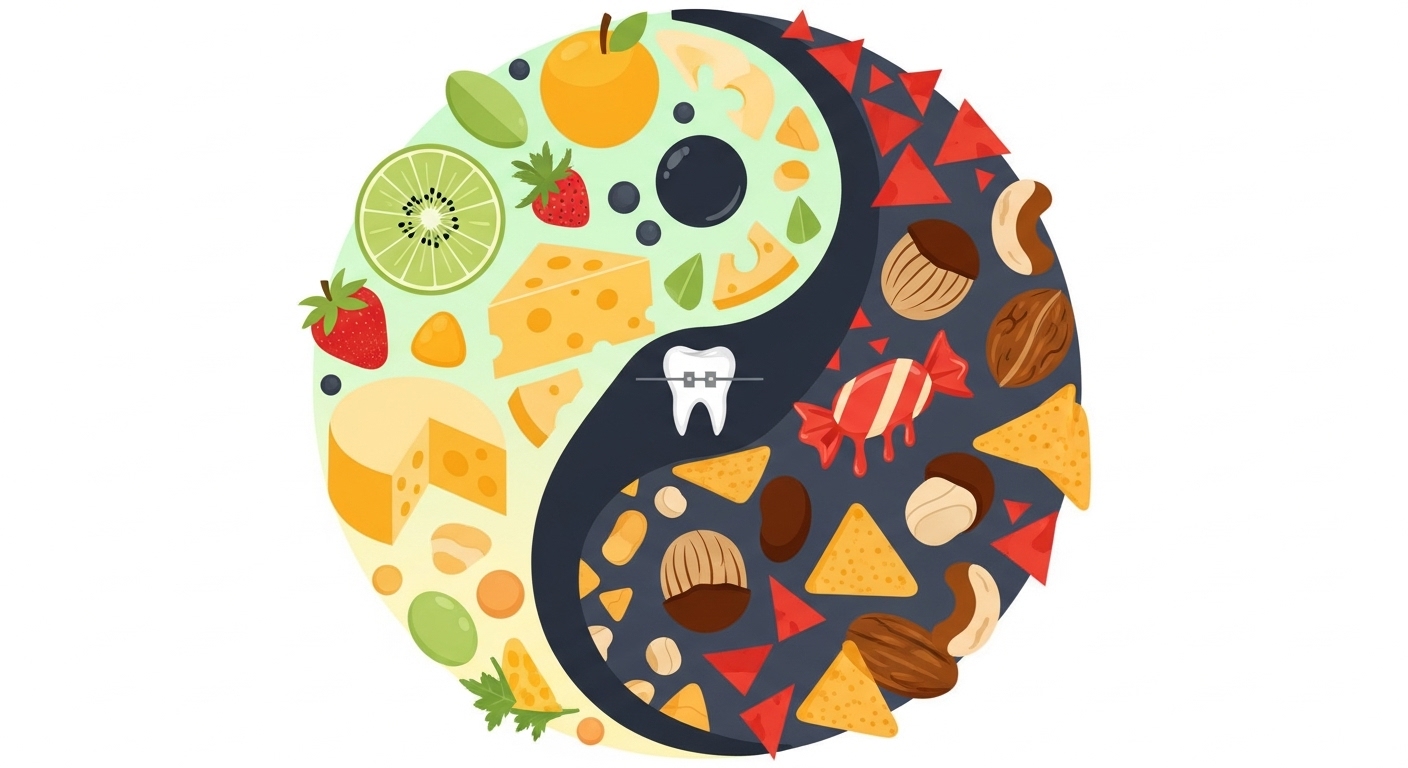
  1. What you should not drink and eat,

    • a. drinks with high acidity - coca cola, fanta, pepsi, sprite, etc. - the acidity wears away the composite with which we attach the braces and damages the tooth enamel.
    • b. sticky food, candies, toffees, caramels, chewing gum, corn, etc.
    • c. hard, small food that cannot be broken down - hazelnuts, chips, popcorn, crackers, dried fruits, etc.
  2. What you can eat and drink with caution.

    • a. hard food that can be broken down - hard fruits, vegetables, meat, bread, toast, hamburger, etc. All of this should be broken into smaller pieces with a knife or hands before eating and ONLY CHEWED with the back teeth and in no case BITTEN with the front teeth.

    • b. food that contains hard particles - olives, peaches, apricots, meat, chicken, fish, etc. They all contain pits or bones, which should be removed before eating, and one should eat with caution.

In addition, bad habits such as chewing on a pen, pencil, or nails can also damage both the teeth and the braces.

More articles

Your 3D bite model: how orthodontists use it and why it isn't a promise

Your 3D bite model: how orthodontists use it and why it isn't a promise

3D bite model in orthodontics: how a Dubai orthodontist uses it, why a simulation isn't a guarantee, and how biology, wear and refinements shape results.
Digital treatment planning: what your orthodontist sees that you don't

Digital treatment planning: what your orthodontist sees that you don't

Digital orthodontic treatment planning in Dubai: scans, X-rays, photos, roots and bone. What your orthodontist reads behind the 3D animation.
How to read your orthodontic treatment plan, line by line

How to read your orthodontic treatment plan, line by line

How to read an orthodontic treatment plan: diagnosis, goals, appliance, timeline, retention, fees. Questions to ask and red flags to spot.
Digital dental scan vs impressions: why you no longer need the tray of goop

Digital dental scan vs impressions: why you no longer need the tray of goop

Digital dental scan vs impressions: how an intraoral scan works, how accurate it is, and when a Dubai orthodontist still takes a classic mold.
Dental CT radiation dose: how safe is a CBCT scan, in real numbers

Dental CT radiation dose: how safe is a CBCT scan, in real numbers

Dental CT radiation dose in microsieverts: CBCT vs OPG vs periapical, compared with background and flights. ALARA, pregnancy, children.
OPG vs cephalometric X-ray vs CBCT: how dental scans differ and what each shows

OPG vs cephalometric X-ray vs CBCT: how dental scans differ and what each shows

OPG vs CBCT vs lateral ceph: what each dental scan shows, typical doses, and when a Dubai orthodontist actually needs 3D.
Why your orthodontist needs so many X-rays and photos before treatment

Why your orthodontist needs so many X-rays and photos before treatment

Why an orthodontist needs X-rays and photos: OPG, cephalogram, CBCT, photo series and scan. What each shows, radiation dose, and when repeats are needed.
Your first orthodontist consultation, step by step: what happens and how to prepare

Your first orthodontist consultation, step by step: what happens and how to prepare

First orthodontist consultation in Dubai, step by step: history, exam, photos, scan, X-rays, treatment options and next visit.
TMJ surgery: when orthodontics alone is not enough

TMJ surgery: when orthodontics alone is not enough

TMJ surgery is a rare step after conservative care. How joint surgery differs from orthognathic surgery, and how I coordinate care in Dubai.