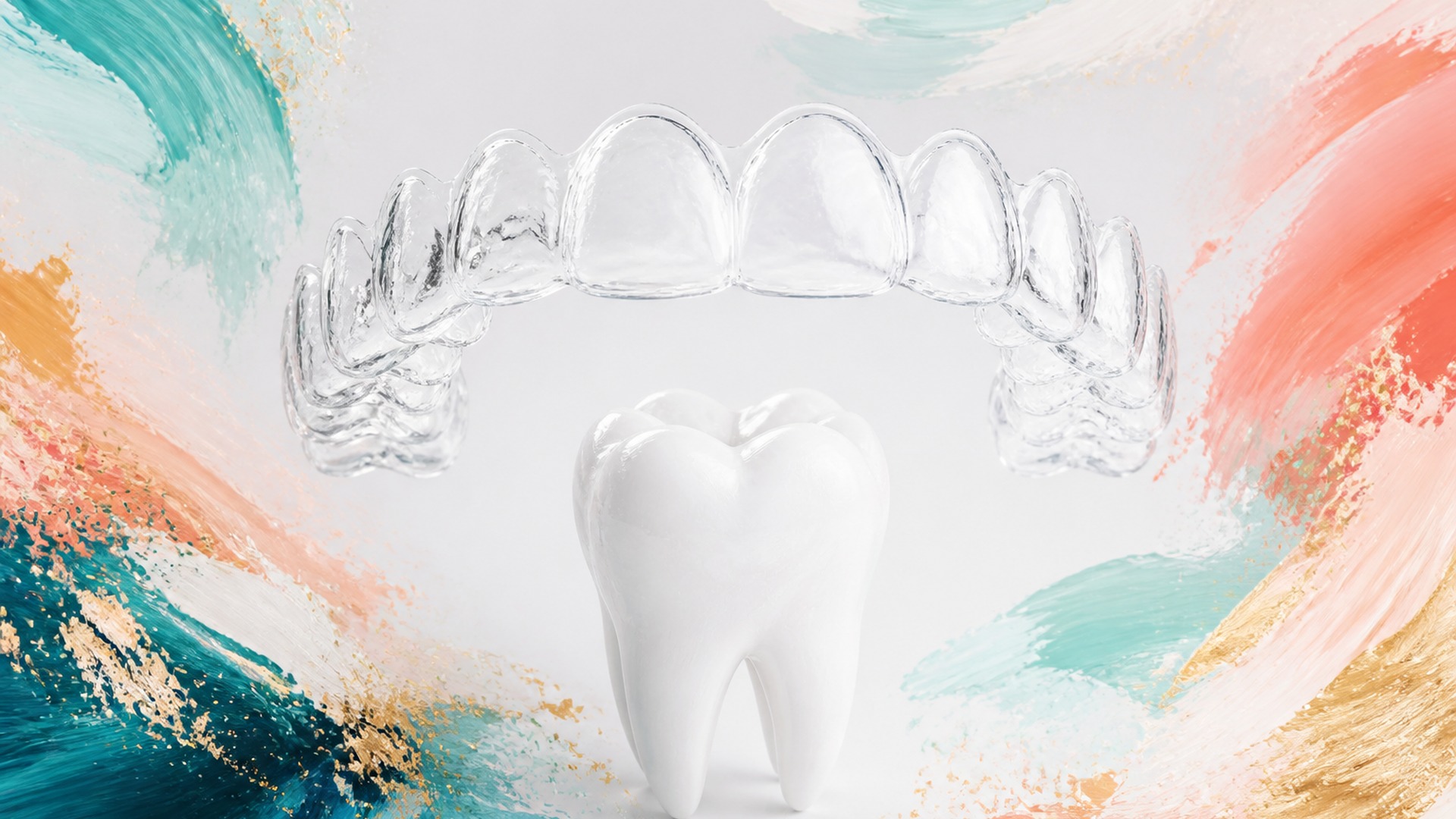
A clear aligner moves a tooth with elastic push from a plastic shell shaped a little ahead of where the tooth sits today. The tray seats on the crowns, flexes, and as it tries to spring back to its programmed shape it presses on enamel. Bone around the root responds by remodeling: tissue gives way on the pressure side and builds on the tension side. I practise in Dubai as a specialist orthodontist, and on consultation I walk patients through that chain — from scan and 3D plan to composite buttons on the teeth, wear hours, and plan revision with an extra tray series. Below is how aligners deliver force, which movements track more reliably, where geometry limits the shell, and why the screen animation and the fit in your mouth sometimes diverge. Only an exam with records sets timelines for your case; I do not diagnose from photos online.
What the clear shell does to a tooth
Patients often want the braces story with a transparent costume. Braces deliver force through a wire and bracket: the wire pulls and pushes; the bracket holds the application point. Aligners use different physics. One thermoplastic shell wraps occlusal, buccal, and lingual surfaces at once. Load comes from a shape mismatch: the tray “wants” the next planned position while the tooth stays in the current one. Worn 20–22 hours a day, plastic presses on contact zones. The American Association of Orthodontists describes tooth movement as a biological response to controlled force — the same for trays. Force reaches the tooth through elastic rebound of a shell, not a continuous archwire. Adult aligners and Invisalign pages outline system scenarios; here I cover the shared principle of any certified tray. Three layers below show why “put it on and it straightens itself” fails.
Plastic spring-back and the planned mismatch
Each tray in the series is not a copy of today’s teeth. The lab thermoforms the plate over a model where selected teeth already sit fractions of a millimetre toward the next step. When you seat the aligner it resists at first: margins snap with effort, the occlusal surface flexes. Then the material tries to recover its geometry and transfers pressure to enamel. A larger programmed step means stronger initial deflection — and a higher chance the tray will not seat fully or will rock. Sensible staging therefore cuts a long path into small portions: many protocols and papers land near 0.1–0.3 mm per stage for linear moves, with rotations cut even finer. On an aligner treatment plan I lock goals and acceptable steps before manufacturing. “Finish in ten trays” sounds sharp in an ad; biomechanics answers with lost root control.
Material is part of the force. Thickness and stiffness change how quickly load decays after insertion. Pressure is higher in the first hours, then eases as the tooth shifts a little and contact evens out. A short removal for a meeting plus a long stretch without the tray does more than break discipline — it discards the micro-progress of that stage. Twelve hours of wear instead of twenty-two leaves the tooth short of the programmed mismatch while the next tray already expects the next geometry.
Force on the crown, not a magnet on the root
The aligner pushes the crown. The tooth’s centre of resistance sits closer to the root, inside bone. Force applied above that centre favours tipping: the crown moves, the root lags. Biomechanics reviews from 2024–2025 using finite-element models show the same pattern again: without engineered contact geometry and without composite buttons, the system prefers tipping and intrusion over bodily root translation. That is not a brand flaw. It is geometry: the shell holds the visible crown while the root sits in the socket and follows lever rules.
That is why plans add composite buttons, ridges, hooks for elastics, and sometimes skeletal anchorage. They change the point and direction of the force couple so crown and root travel closer to the intended path. If a patient asks for “no bumps on the teeth for photos,” I price the refusal: some movements become less predictable and the chance of an extra tray series rises. Pretty enamel for a selfie and a stable bite are different bills.
Why the tray must seat tightly
Force travels only where contact holds. If the tray lifts at an incisal edge, flaps on a molar, or fails to click over a composite button, the planned vector smears. Patients feel this as “the tray keeps popping off” or “it hurts but nothing moves.” At review I check seating in detail: gaps, rock, worn buttons, match to the stage. Poor seating is not a reason to “tough out the same tray another week.” It is a tracking signal: chewies on the current tray, drop back one stage, restore buttons, or rescan.
Tight seating depends on tooth shape, scan quality, and wear habits together. Conical crowns with short clinical height hold a tray worse than teeth with clear anatomy. Composite buttons act as handles the shell can grip. Without them plastic slips. I keep the wording plain: without a grip surface the tray loses purchase and force leaks away.
Biology: how bone and the ligament answer force
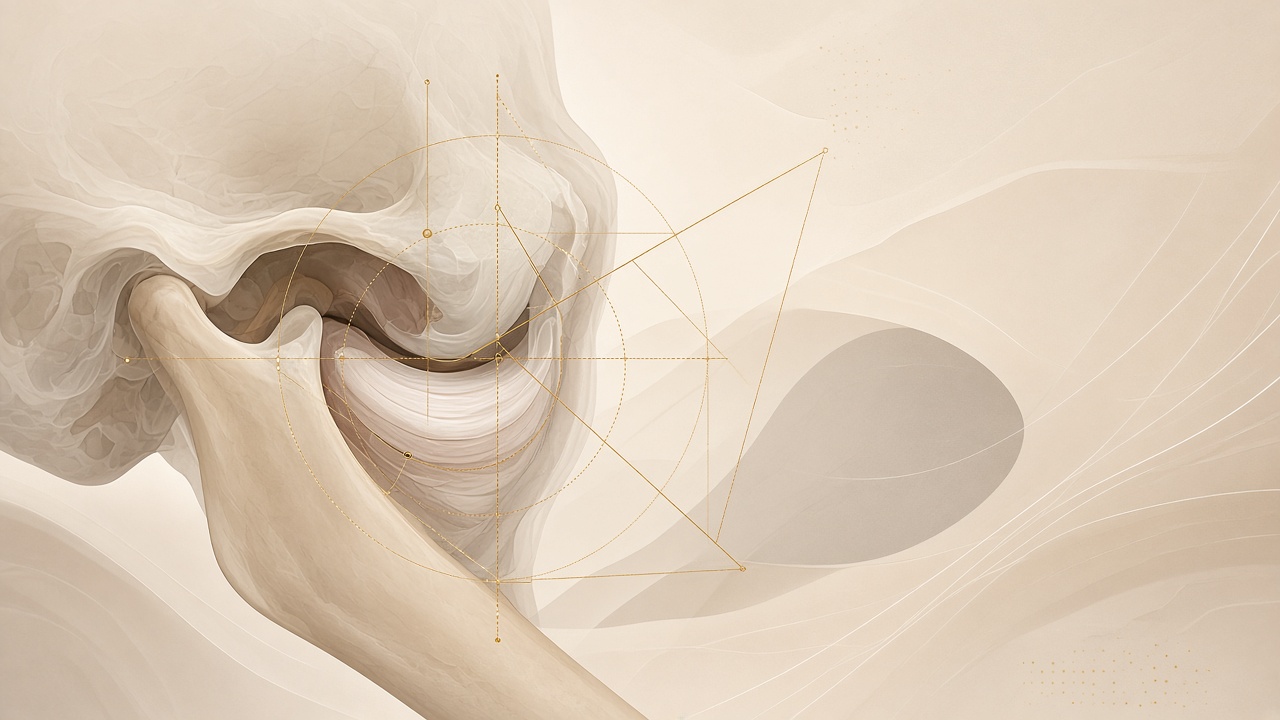
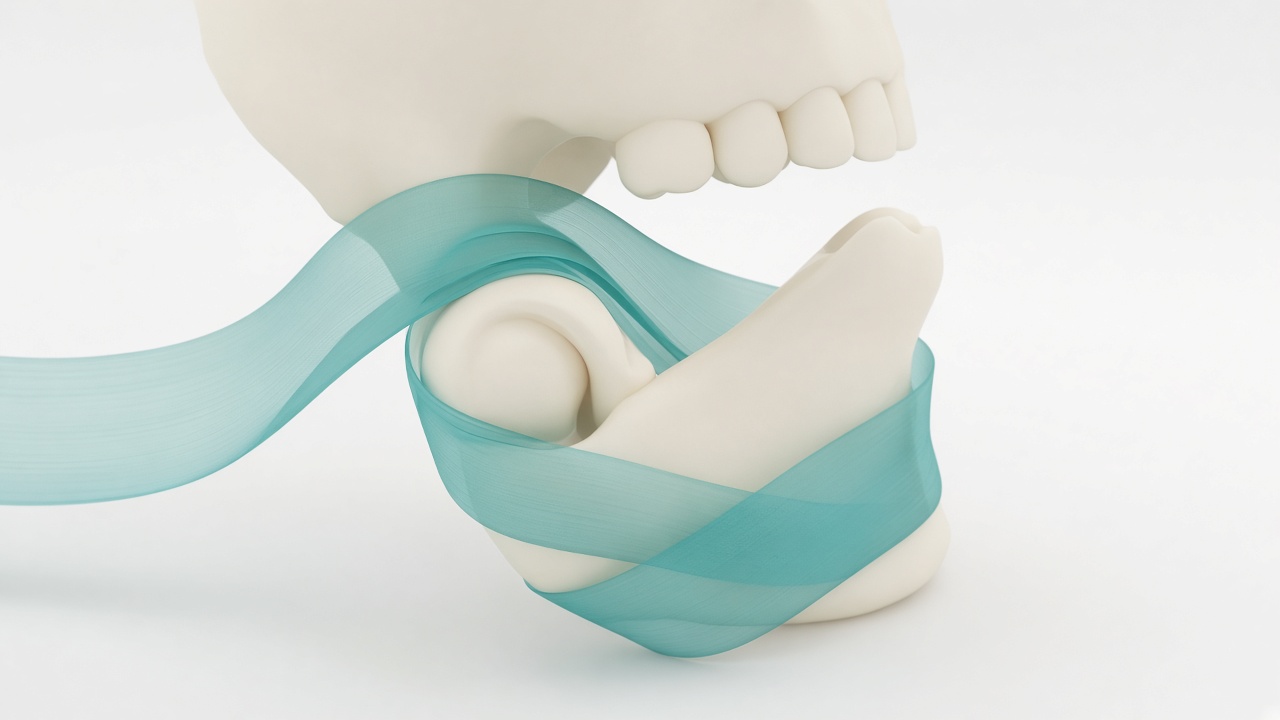
Plastic sets the direction. Living tissue does the moving. Between root and bone sits the periodontal ligament — a thin cushion of fibres, vessels, and cells. When the tray presses the crown, the ligament compresses on one side and stretches on the other. Bone cells get the signal: free space here, build support there. Orthodontics has used that response for decades; aligners do not cancel biology, they only change how load is delivered. On consultation I tie timeline expectations to periodontal health, bone age, and systemic factors — the same tray behaves differently on a healthy ligament and on inflamed gums. Smoking, untreated periodontitis, and some systemic conditions slow or distort bone response — reviews catch that earlier than a marketing reel. Three biological layers patients rarely see in a glossy “teeth slide by themselves” animation follow.
The periodontal ligament and the early ache
The first days of a new tray bring pressure and a dull ache for many people. That is not a broken tooth. It is ligament and vessels adapting to new load. Peak discomfort usually sits in the first 24–72 hours, then falls. Sharp pain that climbs toward the end of the week or blocks soft chewing is a reason to come in early: the step may be too large, the tray may not have seated, or inflammation may be amplifying force. “Take a painkiller and push through” without an exam is not a course strategy I endorse.
The ligament also serves normal chewing: the tooth springs slightly in its socket. Orthodontic force must be enough to start remodeling and mild enough not to crush ligament vessels. An oversized step on a short series gives a hard start and weak control. The same logic sits behind wear hours: the ligament needs time under steady light load, not rare pressure spikes between long gaps without a tray.
Bone resorption and formation
On the pressure side, bone gradually clears a path for the root. On the tension side, it builds support. That exchange is tooth movement. Speed has biological caps: adult bone turns over differently from adolescent bone; smoking, poorly controlled diabetes, and active periodontitis change the answer. I do not promise “a millimetre a week” from a slogan. I read films, the periodontium, and age, then set a corridor. For adult aligners that matters: after the thirties and forties bone responds more tightly to load, and goals often include working occlusion as well as front-tooth aesthetics.
I order CBCT selectively — impacted teeth, bone-volume doubts, root assessment. A panoramic film and a lateral cephalometric radiograph when indicated remain the base. Without a map of bone, the on-screen plan is a pretty hypothesis about crowns.
Pace, pauses, and “accelerators”
Biology likes rhythm. Changing trays too fast before the tooth is ready leaves an under-tracked stage. Changing too slowly stretches the course and dulls habit. Some systems allow 7–14 day changes under the doctor’s protocol; the call is individual. Ad “accelerators” — from vibration gadgets to promises to cut treatment in half — I treat carefully: evidence is mixed, and the risk of skipping review often outweighs a Stories claim. If a patient wants speed, I check tracking and hygiene first. Speeding a plan that already lags at the chair is pointless.
A two-week holiday without trays often buys an extra tray series later. Teeth remember prior positions and tend to relapse until retention locks them. I ask patients to plan travel with the tray calendar, not against it.
Digital plan and staging: from scan to tray series
Before the first tray you buy clarity. The scan captures tooth surfaces and nearby soft tissue. A photo protocol locks aesthetics and later comparison. Films show roots, bone, impacted units, and skeletal background. On that base the doctor builds a 3D plan: which teeth move where, in what order, where composite buttons sit, where enamel reduction between contacts creates space, where elastics enter. An aligner treatment plan in my practice lists from AED 600 on the site — a service floor, not the full-course invoice. Full system packages start higher on the service pages — for example Invisalign from AED 22,000 — and depend on complexity after examination. Without an agreed plan the lab stamps plastic blind, and you buy a box instead of a course. Three planning layers patients often collapse into one product name follow.
Records before the first tray
A free ten-minute scan introduces the technology. It rarely replaces review of bite, joints, and periodontium. The AAO links discussion of options to a full evaluation. In Dubai you add the Dubai Health Authority frame: the specialist works within specialty and facility privileges. At the exam I answer “are trays appropriate at all” before “which system and which package.” Sometimes the honest path is a hybrid or braces for a phase where a shell poorly controls the root. That is tool choice, not brand blame.
If you bring films from another country, I weigh age and quality. A blurry panoramic from three years ago saves little and risks much. Reshooting is cheaper than building a series on an outdated bone map.
Staging: why the path is sliced
A large move in one jump breaks seating. Staging spreads motion over time: create space, then move a group, while protecting anchorage. On screen it looks like a video. In the mouth each frame is a separate tray with its own force. A pretty video with aggressive staging yields trays that stop seating by mid-series. I edit before approval: shrink steps on hard teeth, add buttons, change order. Signing “I like the picture” without a talk on wear and risk turns the course into a lottery.
Order matters. Closing front crowding before space exists makes teeth collide and the tray skate on the occlusion. Enamel reduction or arch-form change in the plan is space for force vectors, not cosmetic fluff.
Simulation versus the mouth
Digital simulation shows crowns. It does not guarantee the root will track the line or that the periodontium will tolerate the pace. Finite-element work stresses that predictability hinges on contact geometry, activation size, and auxiliaries. Clinically I translate that into visits: every few trays we check tracking. If a tooth lags the model, the next tray already lies. Then we stop blind progress through the box and decide: finish the stage, step back, or rescan for a plan revision.
Patients sometimes ask for “all trays at once and fewer visits.” Some short protocols allow wider intervals. For a full course, sparse reviews raise the odds of a pretty middle and a crooked finish. I write the schedule next to the estimate.
Composite buttons, enamel reduction, and elastics
A bare shell handles some tipping and light shifts well. Complex paths almost always need handles and space. I call the tooth-coloured composite bumps on enamel composite buttons; at first mention you may also hear “attachments.” They show up close and fade in ordinary conversation. Enamel reduction between contacts creates a micro-gap. Elastics link the jaws when one tray cannot solve an inter-arch task. On the aligners category page these tools sit inside treatment logic, not as comfort add-ons. Refusing every auxiliary “for simplicity” often returns as a plan revision a few months later. I mark where buttons and enamel reduction will appear before start, so the mirror holds no surprise on day one. Below is what each does, without romance and without scare copy.
Composite buttons on the teeth
A button increases the surface the tray can push in a chosen direction. Rectangular, beveled, and elliptical shapes match the vector: premolar rotation, tip control, help with extrusion. Placement takes minutes after plan approval: a template, composite, light cure. Removal comes at finish or when the plan changes. In a sound package, place and remove sit inside the fee; a per-button surcharge is a question to ask before you start.
Skipping buttons for “clean teeth on camera” can work in very simple cases. In most adult scenarios refusal lowers predictability. If a button chips, that tooth loses grip and tracking drops locally. Do not wait months for the next review: a short repair visit costs less than a new series.
Enamel reduction (IPR)
Interproximal reduction removes microns of enamel between contacts so crowded teeth can align without expanding the arch where expansion would harm. It is done in stages with measured gaps. It is not “filing the teeth down” from internet myths. With proper technique and hygiene the contact stays smooth; caries risk tracks home care more than the procedure itself. I state where reduction will happen before you start and lock it in the plan. If a patient refuses both reduction and expansion, the space math fails — and the tray owes no miracle.
Inter-arch elastics and other anchorage
Elastics hook onto buttons or precision cuts for the hours the doctor sets. They pull the jaws in Class II, Class III, or midline schemes. Without elastics the tray mostly moves teeth inside one arch and weakly fixes jaw relationship. Discipline matches tray hours: an elastic in a pocket does no work. In harder molar distalisation or anchorage control we sometimes discuss mini-implants. That is a separate risk talk, not a default package line.
Which movements trays prefer — and which fight back
Predictability is the practical question after “how does it work.” Biomechanics reviews and chairside experience agree: crown tipping and relative intrusion come more readily; bodily translation, big rotations of round teeth, extrusion, and root torque need more engineering and more often need a plan revision. The table is a talking map for the exam, not an online diagnosis. Your case may mix easy and hard zones in one arch.
| Movement type | What the tooth does | How the tray delivers force | What we usually add | Typical tracking failure | What I check at review |
|---|---|---|---|---|---|
| Crown tipping | Crown leads, root lags | Direct shell push on enamel | Often firm seating alone | Over-tip if the step is large | Incisal contact with the tray |
| Intrusion | Tooth settles into the socket | Pressure on occlusal / incisal | Buttons for grip on short crowns | Unseated tray, local open bite | Vertical gap under the tray |
| Bodily translation | Crown and root move nearer parallel | Needs a force couple, not one push | Buttons, ridges, fine staging | Tip instead of translation | Root position clinically / on film |
| Rotation | Tooth spins on its axis | Tray grips bulges; round teeth slip | Buttons on premolars / canines | Tooth under-rotates, tray spins | Button seat in the tray well |
| Extrusion | Tooth is drawn out of the socket | Shell struggles to pull along the axis | Buttons, elastics per plan | Tooth lags, neighbour compensates | Gingival margin height, contact |
| Root torque | Root moves buccal / lingual | Crown force sits far from resistance centre | Buttons, tray geometry, sometimes anchorage | Pretty on-screen torque without clinic | Buccal-lingual crown tip |
| Molar distalisation | Molar moves back along the arch | Complex vector plus front anchorage reply | Buttons, elastics, sometimes mini-implants | Front flaring as anchorage cost | Incisor anchorage, occlusion |
| Space closure | Teeth move toward each other | Stops on contact surfaces | Small steps, tip control | Black triangles, tipping | Contacts and papillae |
I show this logic on the plan before you pay for a full series. If hard rows dominate the simulation, I flag the chance of an extra tray series early — one box to a finished smile is the marketing exception, not the clinical rule.
Wear hours and tracking: why plans leave the rails
Mechanics need contact. Contact needs hours. Most protocols hold 20–22 hours a day: trays out for food and cleaning, then straight back in. Five “five-minute coffee breaks” without a tray become hours of downtime. The tooth does not usefully rest — it loses the micro-shift of that stage. At reviews I compare the mouth with the plan: that is tracking. Good tracking means we advance. Poor tracking means fix now, before a stack of loose trays piles up. In Dubai, flights, late dinners, and long office days add extra holes — better to agree a wear schedule at start than to repair mid-course. An honest talk about hours saves months of drift. Three everyday layers that weaken strong paper biomechanics follow.
Wear hours and Dubai habits
Removing trays for every meal is normal. Leaving them in a napkin for a two-hour lunch in Dubai Marina is a hole in the stage. Hot drinks inside a tray stress plastic; eating in a tray wrecks hygiene and material. Night wear is mandatory: sleep covers a large slice of the daily hour count. Waking without a tray means the stage under-delivers almost every night. I ask for an honest first-week log — not school surveillance, but a map of real UAE rhythm: flights, late dinners, training, Ramadan schedules when relevant.
For teens and busy adults I sometimes set reminders and closer early visits. Technology does not build habit alone. Habit keeps technology working.
Signs tracking is already slipping
The tray still fights after a week of “getting used to it,” when seating should ease. Gaps appear at an incisor edge. The occlusal surface will not seat even with chewies. A button misses its well. A neighbour tooth races ahead of a laggard. Any of these warrants a message to the clinic before the box ends. Sometimes you drop back one tray for a few days. Sometimes a button needs repair. Sometimes you need a scan and a plan revision.
Pain that rises toward the end of a tray’s wear window is also odd: discomfort is usually higher at the start. Climbing pain late may flag inflammation, occlusal trauma, or a cracked tray.
When a plan revision is due
A plan revision means a new scan and an extra tray series when teeth left the path or the finish needs detail the first series missed. Ads cast that as failure. In full-course clinics it is a common, honest stage. Causes vary: under-worn hours, chipped buttons, optimistic staging, bone slower than the model, a mid-course goal change (“now fix these two as well”). I raise the topic before start so the surprise is only the volume, not the fact.
My site has no universal “revision” price line: a round is by estimate / inside the package or billed apart. The plan from AED 600 is the floor for rebuilding aligner logic when a fresh written outline is needed. A full system restart sits at higher floors on the service pages. Ask how many extra series your contract includes before you pay a deposit.
After the last tray: retention is still mechanics
Movement stops — ligament and bone still remember the old place for months. Without retention, teeth tend to return, especially rotations and spaces after closure. A retainer is not a souvenir; it continues position control. Removable retainer trays and bonded wires on the tongue side solve different jobs; many patients use both. I discuss retention in the same visit where I explain how an aligner works: otherwise patients treat finish as the moment physics switches off. Physics does not switch off.
Hygiene around a bonded wire and discipline with a removable tray are separate skills. Losing a retainer on a flight is a reason to call quickly, not to wait until teeth “settle.” If you choose care under aligners, put retention in the budget and the calendar from day one.
Clear aligner care is contact engineering plus bone biology plus your wear rhythm. The tray pushes. Bone answers. The plan sets order. Buttons and enamel reduction help where tooth shape alone is weak. Reviews catch drift early. A plan revision finishes detail the first series left open. To map your case on this frame, start with consultation and records — not a mail-order box from a photo.
FAQ
Do aligners move teeth slower than braces?
Not always. Speed depends on movement type, wear discipline, and biology more than on the plastic brand alone. Some tipping and front alignment on trays matches braces when tracking is solid. Complex root control and some vertical tasks are often easier to steer with fixed appliances. Comparing “average months online” without an exam is empty. At consultation I set a corridor for your bite, not for someone else’s reel.
Can I do aligners without composite buttons on the teeth?
Sometimes — in very simple cases with favourable crown shapes. In most adult scenarios buttons raise grip and predictability. If you refuse them for photos, we state which moves weaken and how much the chance of an extra tray series rises. We lock that before manufacturing. Do not chip buttons off yourself: you break the stage mechanics.
Why does a tray feel tight for days, then feel loose?
At the start of a stage the shape mismatch is largest, so pressure feels higher. As the tooth micro-shifts, contact evens and the force feel drops — that is expected. If looseness arrives too soon and the tray rocks, the stage may have under-collected hours or the tooth may have drifted off path. Message the clinic before you jump to the next tray. A freer feel at the end of two weeks after a firm start is often normal; a floppy tray on day three is a red flag.
How many hours a day should I wear clear aligners?
Most protocols aim near 20–22 hours. Out for food and cleaning, straight back in. A night without trays almost always breaks the daily target. I fix the exact number and allowed windows for your plan at start. If Dubai travel life cannot support 22 hours, say so early rather than under-wear in silence and discover it at review.
What is a plan revision — does it mean treatment failed?
A plan revision is a new scan and an extra tray series to finish or correct the path. For full courses it is a common clinical stage, not automatic failure. Causes sit in wear, biology, and movement difficulty. See in the contract whether a revision round sits inside the package and how many rounds are included. I say this before the deposit so the word is not a late surprise.
How is Invisalign different from other trays in how they work?
The base principle is shared: an elastic shell on a digital plan pushes crowns. Labs, planning software, material protocols, doctor toolkits, and case-transfer service differ. The Invisalign page and the aligners category cover system choice. “Tray pushes — bone answers” stays common. I do not start a brand war without your bite on the table.
Does the on-screen simulation guarantee my result?
The simulation shows an agreed crown goal and staging. It does not promise a millimetre copy in the mouth or replace root and periodontal biology. I use the video as a language for goals and risks, then verify at reviews. If someone sells the animation as a photo guarantee, read the contract. The clinic confirms the outcome, not the render.
I already bought online trays from a home kit — do I still need an exam?
Yes. Mail-order trays without orthodontic assessment skip bone, roots, and occlusion. I do not continue a remote course blind: exam first, films as indicated, seating and risk review. Sometimes we convert the logic into supervised care. Sometimes the safer path is to stop and rebuild. That call comes only after an in-person consultation.